
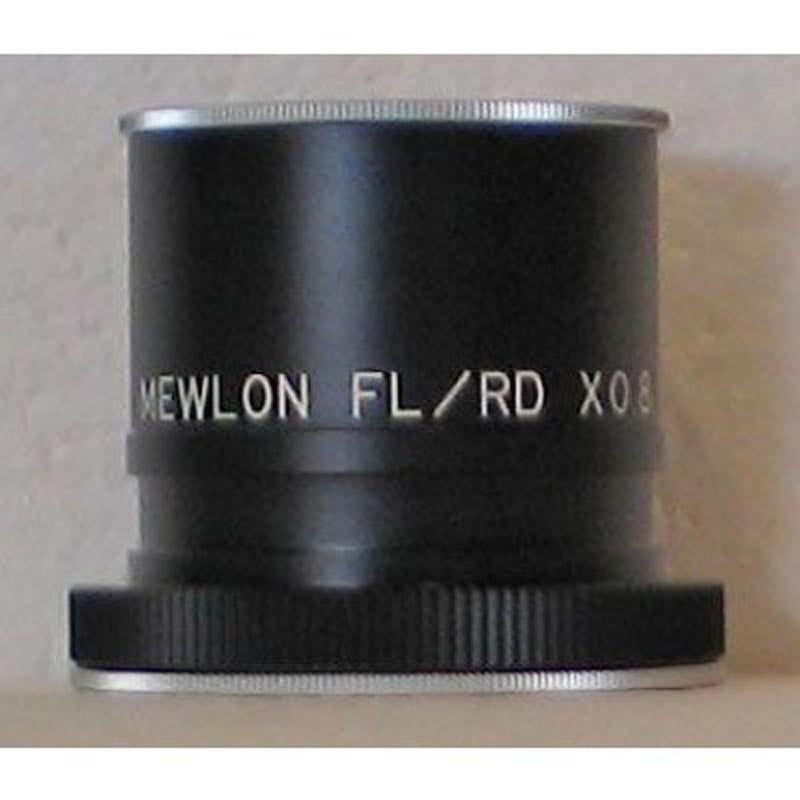

- Description
- Specifications
- Downloads
Product Overview
The M-FLRD is Takahashi's combined reducer, flattener, and corrector for the Mewlon Dall-Kirkham Cassegrain line. On the Mewlon-180C it brings the native 2160mm f/12.0 down to 1760mm f/9.8; on the Mewlon-210 it brings 2415mm f/11.5 down to 1961mm f/9.3, in both cases correcting the field to a 30mm image circle at the same time.
Who It's For
This is a good match if you own a Mewlon-180C or Mewlon-210 and want a faster, flatter field for imaging rather than the native long-focal-length Cassegrain configuration typically used for planetary and lunar visual work.
Key Features & Design
- Three functions in one unit: reduces the focal ratio, flattens the field, and corrects residual aberration for the Mewlon Cassegrain design.
- Mewlon-180C: 2160mm f/12.0 native becomes 1760mm f/9.8.
- Mewlon-210: 2415mm f/11.5 native becomes 1961mm f/9.3.
- 30mm corrected image circle on both telescopes, with a matched 56.2mm back focus.
Optical / Mechanical Design
The Mewlon's Dall-Kirkham Cassegrain design is optimized natively for long-focal-length planetary and lunar work; the M-FLRD trades some of that reach for a faster, corrected field better suited to deep-sky imaging on both the 180C and 210. Because it is a shared design across both apertures, the resulting f-ratio differs slightly between them — f/9.8 on the 180C and f/9.3 on the 210 — while the 30mm image circle and 56.2mm back focus hold constant.
Recommended Uses
Deep-sky imaging on a Mewlon-180C or Mewlon-210 where a faster, flatter field is preferred over the native long-focus Cassegrain configuration; galaxy and planetary nebula framing at a more forgiving focal ratio.
Compatibility and Accessory Notes
Takahashi publishes this reducer/flattener for two Mewlon models.
| Telescope | Native | With M-FLRD | Image circle | Back focus |
|---|---|---|---|---|
| Mewlon-180C | 2160mm f/12.0 | 1760mm f/9.8 | Φ30mm | 56.2mm |
| Mewlon-210 | 2415mm f/11.5 | 1961mm f/9.3 | Φ30mm | 56.2mm |
For spacing this reducer correctly with your camera, see the Takahashi Back Focus Guide.
Good to Know Before You Order
Not for Mewlon-250CRS or Mewlon-300CRS: those larger Mewlon CRS telescopes use the separate Reducer-CR and Extender-CR line rather than the M-FLRD.
Frequently Asked Questions
Is it difficult to set up?
No — it threads to the Mewlon's rear cell in place of the standard visual back, with the 56.2mm back focus fixed by the unit rather than something to measure out separately.
What is it best used for?
Deep-sky imaging on the Mewlon-180C or Mewlon-210 at a faster, corrected focal ratio.
Does the same part work on both the Mewlon-180C and Mewlon-210?
Yes — it is a shared design, with a slightly different resulting f-ratio on each telescope.
Will it work on the Mewlon-250CRS or 300CRS?
No — those models use the separate Reducer-CR/Extender-CR line. If you are unsure which corrector matches your Mewlon, send us the model and we will confirm it.
Bottom Line
The M-FLRD is the matched reducer, flattener, and corrector for the Mewlon-180C and Mewlon-210, trading some of the Mewlon's native reach for a faster, flatter 30mm image circle suited to deep-sky imaging.
| Type | Combined focal reducer, flattener and corrector (M-FLRD) |
|---|---|
| Mewlon-180C | 2160mm f/12.0 native → 1760mm f/9.8, Φ30mm, back focus 56.2mm |
| Mewlon-210 | 2415mm f/11.5 native → 1961mm f/9.3, Φ30mm, back focus 56.2mm |
| Part number | TKA70581 |
Shopping Guide
- Takahashi English Catalog 2025 — PDF, 8.63 MB
- Takahashi Telescope Backfocus Table — PDF, 71 kB
You may also like
Recently viewed
Recent Blog Posts
View all
Your Guide Graph Is Lying to You
Read More

D-Size vs V-Size: A Complete Guide to Telescope Dovetail Systems
Read More

What Is Back Focus in Astrophotography? Telescope Reducers, Flatteners, and Spacing Explained
Read More