
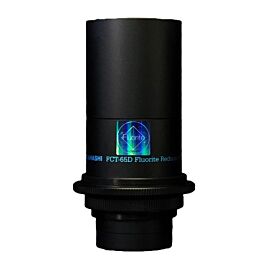

- Description
- Specifications
- Downloads
Product Overview
The FCT-65D 0.65x FU Reducer is Takahashi's dedicated fluorite focal reducer for the FCT-65D refractor. It brings the telescope's native 400mm f/6.2 down to 260mm at f/4.0, and two of its elements are fluorite glass — the material that lets Takahashi push a reduction this aggressive while still holding a flat Φ44mm image circle.
Who It's For
This reducer suits FCT-65D owners imaging wide star fields, nebulae, and comets who want the fastest focal ratio the telescope supports. At f/4.0 it gathers roughly 2.4x the light of the native f/6.2 setup for the same exposure time.
Key Features & Design
- Fluorite reducer elements: control the chromatic error a reduction this strong would otherwise introduce.
- 0.65x reduction: takes the FCT-65D from 400mm f/6.2 to 260mm f/4.0.
- Φ44mm corrected image circle: covers a full APS-C sensor with sharp stars into the corners.
- M55.9 thread mount: installs directly into the FCT-65D drawtube system.
Optical / Mechanical Design
The reducer sits mostly inside the FCT-65D's drawtube, so the aggressive 0.65x reduction adds little to the telescope's front-to-back balance. It pairs with the included CA-35 (FURD) spacing ring, which sets a fixed back focus of 56.0mm measured from the rear of the adapter rather than from the telescope's own focal plane — the figure to build your imaging train from. See the Takahashi Back Focus Guide for the full spacing chain.
Recommended Uses
Wide-field deep-sky imaging of nebulae, clusters, and large galaxies; comet photography where a fast focal ratio shortens the exposures needed on a moving target; general FCT-65D astrophotography where exposure time is at a premium.
Compatibility and Accessory Notes
| Telescope | Resulting focal length | Resulting focal ratio | Image circle | Back focus |
|---|---|---|---|---|
| FCT-65D | 260mm | f/4.0 | Φ44mm | 56.0mm (from rear of adapter) |
The CA-35 (FURD) spacing ring ships with the reducer and fixes the 56.0mm figure above. Camera-side spacing from there follows your camera's own flange distance — the Takahashi Back Focus Guide covers the full chain.
Good to Know Before You Order
Built specifically for the FCT-65D: the figures above are for that telescope only — other Takahashi refractors pair with their own dedicated reducers.
Frequently Asked Questions
Is it difficult to set up?
No — it threads into the FCT-65D drawtube along with the included CA-35 spacing ring, and the 56.0mm back focus figure is fixed by that ring rather than something you measure and adjust yourself.
What is it best used for?
Wide-field astrophotography on the FCT-65D, where the 0.65x reduction to f/4.0 shortens exposures on nebulae, clusters, and comets.
Does it work for visual observing?
No — it's built to deliver a flat photographic image circle rather than a visual, eyepiece-compatible path.
What else do I need with it?
The CA-35 (FURD) spacing ring, included with the reducer, and your camera's own T-ring or adapter to complete the 56.0mm back focus.
Bottom Line
A dedicated fluorite reducer that takes the FCT-65D to 260mm at f/4.0 with a flat Φ44mm image circle, set up with the included CA-35 ring at a fixed 56.0mm back focus.
| Product type | 0.65x FU (fluorite) focal reducer |
|---|---|
| Compatible telescope | FCT-65D |
| Included accessory | CA-35 (FURD) spacing ring |
| Reduction factor | 0.65x |
| Resulting focal length | 260mm |
| Resulting focal ratio | f/4.0 |
| Corrected image circle | Φ44mm |
| Back focus | 56.0mm (measured from rear of adapter) |
| Mount thread | M55.9 |
Shopping Guide
- Takahashi English Catalog 2025 — PDF, 8.63 MB
- Takahashi Telescope Backfocus Table — PDF, 71 kB
You may also like
Recently viewed
Recent Blog Posts
View all
Your Guide Graph Is Lying to You
Read More

D-Size vs V-Size: A Complete Guide to Telescope Dovetail Systems
Read More
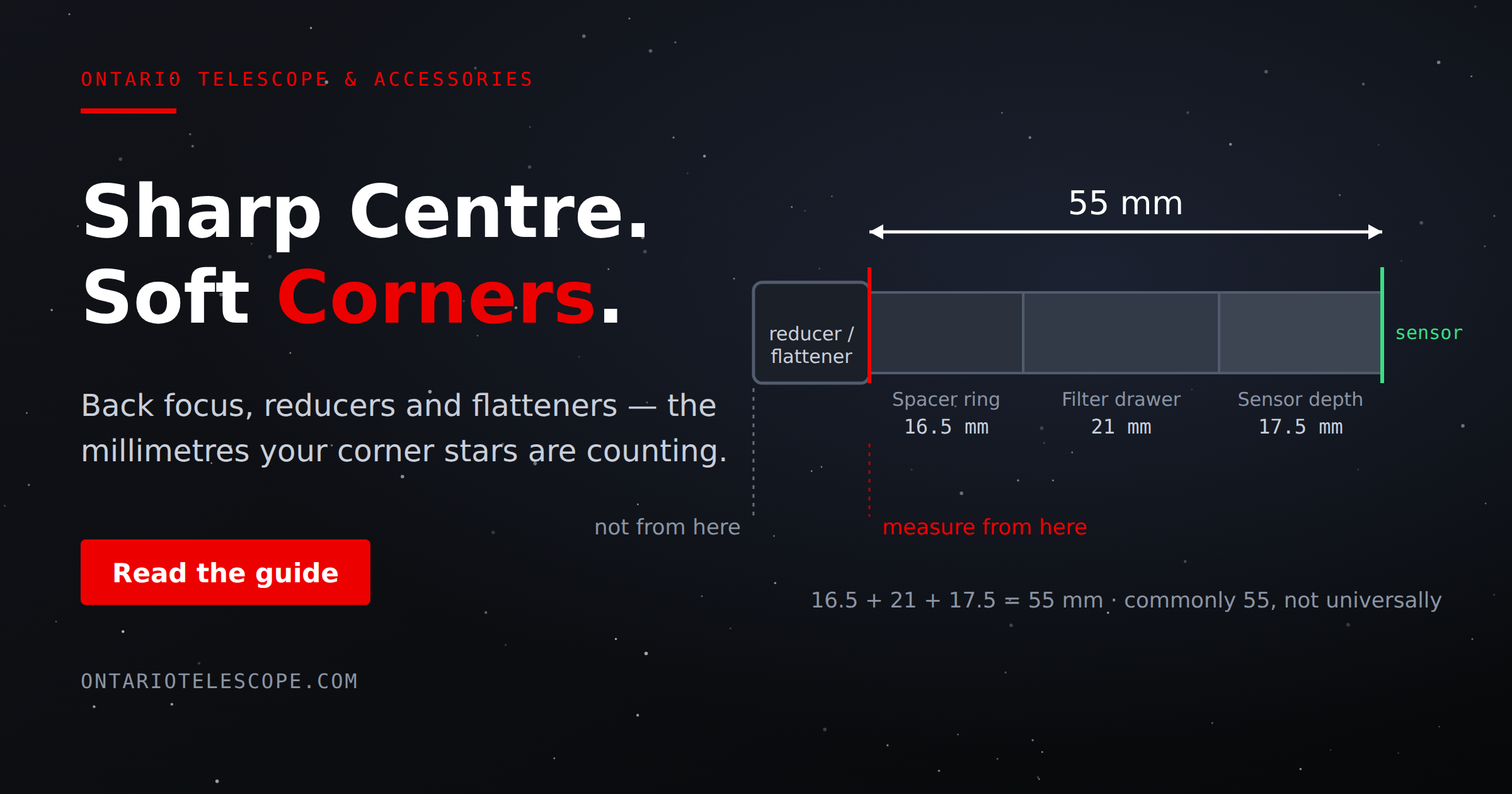
What Is Back Focus in Astrophotography? Telescope Reducers, Flatteners, and Spacing Explained
Read More