


- Description
- Specifications
- Downloads
Product Overview
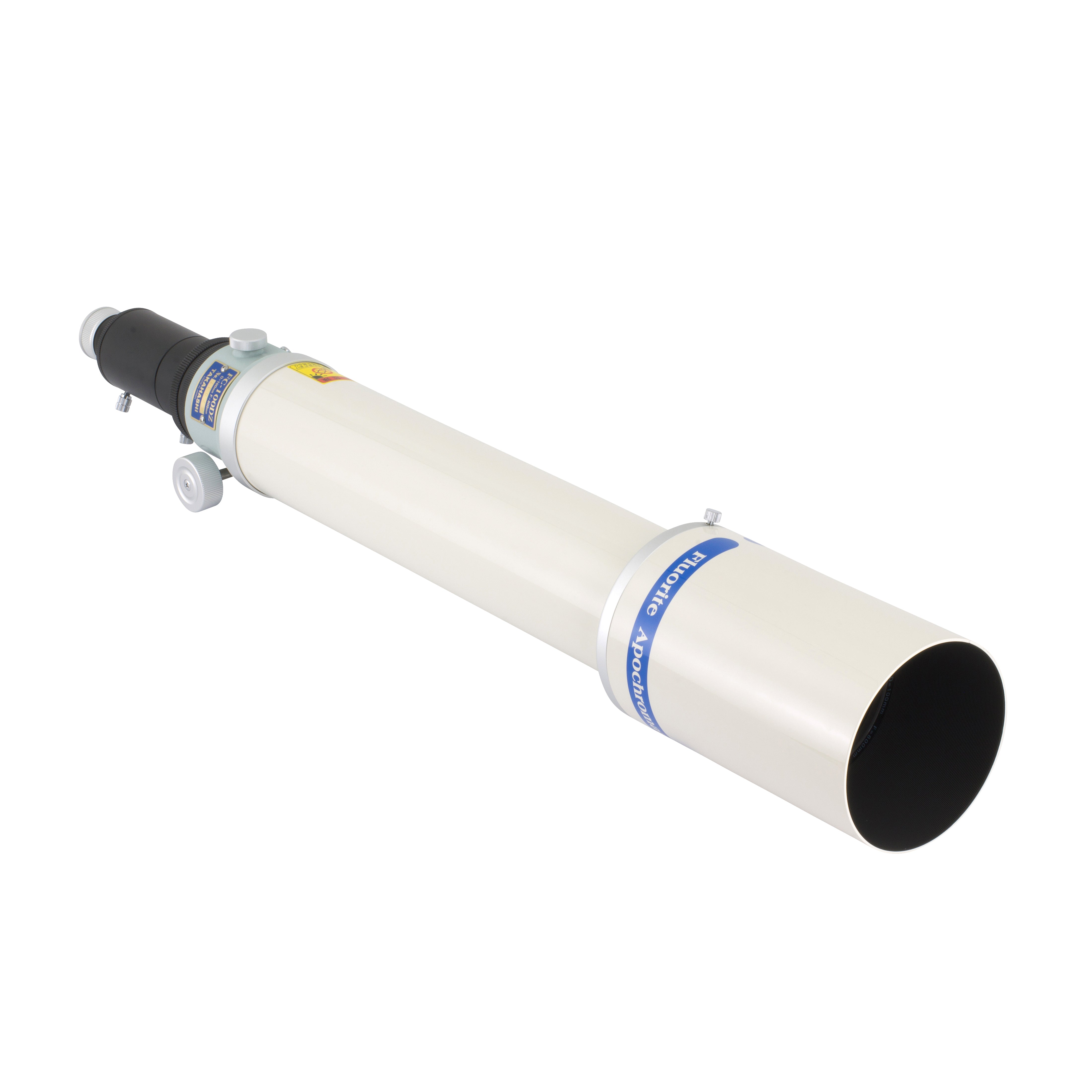
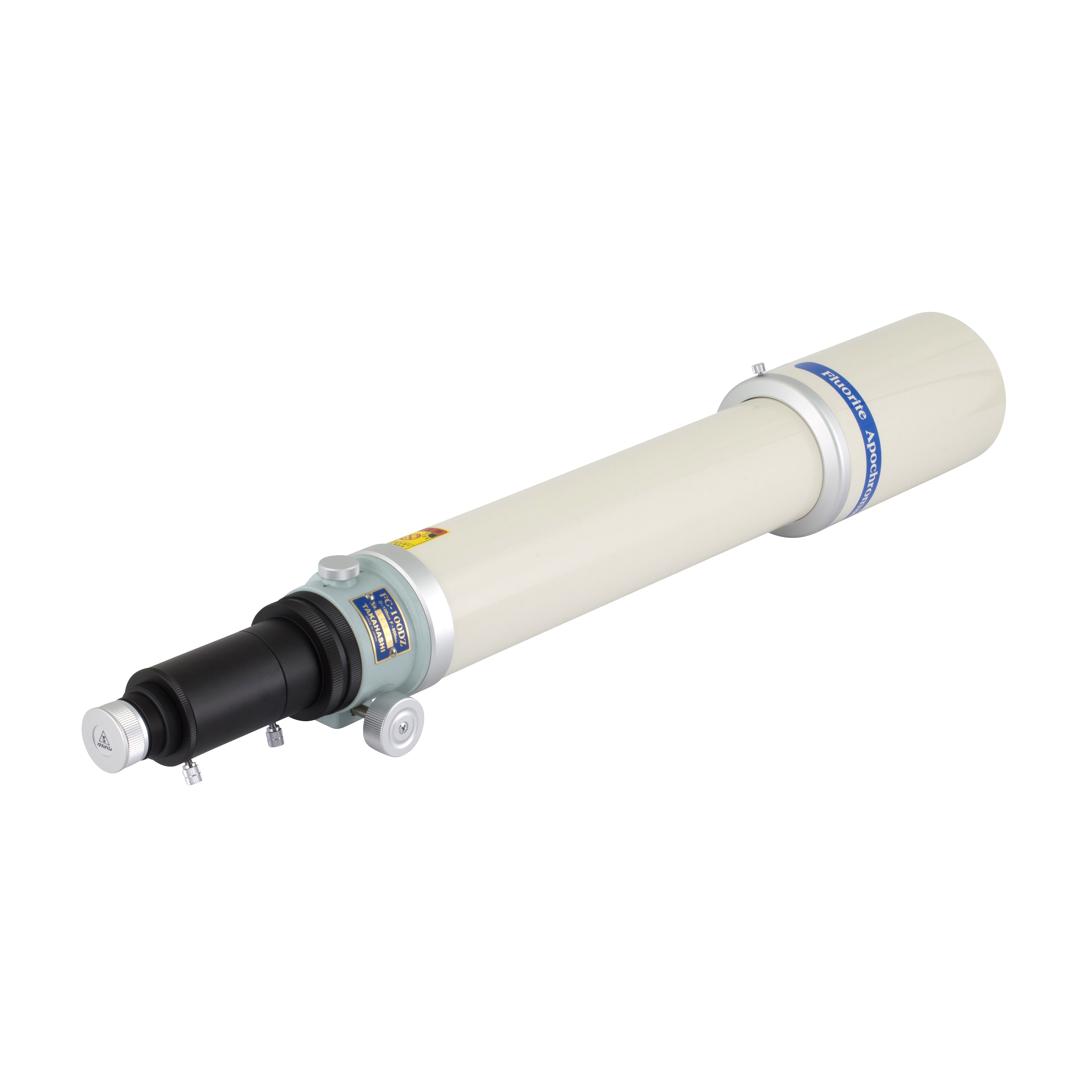
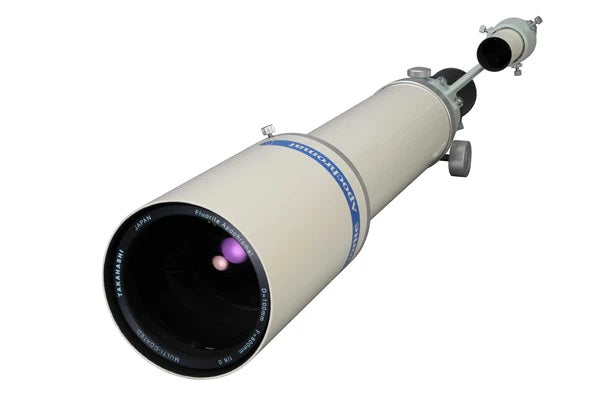
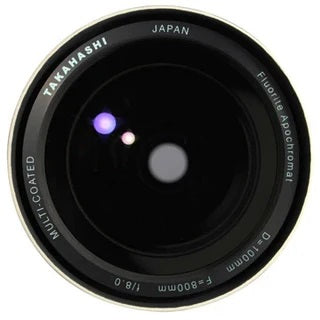
The FC-100DZ is Takahashi's 100 mm fluorite doublet apochromat, the newest member of the FC-100D family. At 800 mm focal length and f/8, it retracts to 770 mm and extends to 840 mm through a variable-length dew shield and tube assembly, weighing 3.7 kg. Back focus at prime is 225 mm, and the doublet uses a fluorite element paired with high-index, low-dispersion glass rather than the Steinheil pairing of the DC and DF.
Who It's For
This is a good match if you want the latest revision of Takahashi's 100 mm fluorite doublet line, with reduced blue halo compared to the FC-100D and compatibility with the existing FC-100 accessory range — flatteners, reducers and adapters already built for the DC and DF fit here too. It suits visual observers after clean, high-contrast lunar and planetary views, and imagers who reduce to 530 mm at f/5.3 with the FC-35RD for wider framing.
Tell us your camera and sensor size and we will confirm which reducer or flattener gets you the field you want.
Key Features & Design
- Fluorite doublet, refined design: two elements in two groups, pairing fluorite with high-index, low-dispersion glass for reduced blue halo relative to the FC-100D.
- 800 mm at f/8: in a 770–840 mm variable-length tube, 95 mm across (124 mm dew shield).
- 2.7-inch rack-and-pinion focuser, single-speed.
- 225 mm of back focus at prime focus — ample room for a full imaging or visual train.
- 63 mm of drawtube extension.
- Compatible with existing FC-100 accessories: the same flatteners, reducers and adapters built for the FC-100DC and FC-100DF fit this tube.
Optical / Mechanical Design
The objective pairs a fluorite element with a high-index, low-dispersion glass element in a two-element air-spaced doublet — a refinement over the Steinheil FC-100DC/DF pairing that Takahashi states cuts blue halo by roughly half. In practice that means tighter colour correction at the same 100 mm aperture and f/8 focal ratio, with the retractable dew shield collapsing the 840 mm tube to 770 mm for transport.
The FC/FS MFL 1.04x flattener brings the system to 820 mm at f/8.2 with a 44 mm corrected circle at 71.2 mm back focus, and the FC-35RD 0.66x reducer shortens it to 530 mm at f/5.3, also 44 mm, at 68.8 mm back focus — the same conversion lenses used across the FC-100D family.
Recommended Uses
- Lunar and planetary observing: at 800 mm and f/8, with reduced chromatic error over the earlier FC-100D.
- Deep-sky imaging at native focal length: 800 mm for medium-sized targets.
- Wide-field imaging: with the FC-35RD 0.66x reducer at 530 mm and f/5.3, a 44 mm corrected circle.
- Flat-field imaging: with the FC/FS MFL 1.04x flattener at 820 mm and f/8.2.
Compatibility and Accessory Notes
Back focus at prime is 225 mm, dropping to 71.2 mm with the MFL 1.04x flattener or 68.8 mm with the FC-35RD reducer. Because the FC-100DZ shares its rear cell with the DC and DF, existing FC-100 flatteners, reducers and adapters fit directly. Takahashi's system charts for the base configuration, the FC-35RD reducer and the EX-Q 1.6x extender are in the Downloads tab, and our Takahashi Back Focus Guide collects the same figures for the whole range.
- Flattener: FC/FS MFL 1.04x, 820 mm at f/8.2, 44 mm circle, 71.2 mm back focus.
- Reducer: FC-35RD 0.66x, 530 mm at f/5.3, 44 mm circle, 68.8 mm back focus.
- Extender: EX-Q 1.6x extends the focal length for planetary and lunar imaging — system chart in the Downloads tab.
- Mount: sold as an OTA — no mount, rings, dovetail, diagonal or eyepiece included. At 3.7 kg plus accessories, a mount rated for 8–10 kg of total payload is a reasonable starting point.
If you already own FC-100DC or FC-100DF accessories and are not sure they carry over, send us the part numbers and we will confirm.
Good to Know Before You Order
- This is an optical tube assembly. Mount, rings, dovetail, diagonal, eyepiece and finder are all sold separately.
- A flat field needs a corrector. At prime focus the field curves; the MFL 1.04x flattener corrects it across 44 mm.
- Back focus changes with each conversion lens. 225 mm at prime, 71.2 mm with the flattener, 68.8 mm with the reducer — the system charts in the Downloads tab list the exact parts.
- The tube length varies with the dew shield position. 770 mm retracted, 840 mm extended — worth accounting for in a case or travel bag.
Frequently Asked Questions
Is it difficult to set up?
No. At prime focus with a diagonal and eyepiece it is straightforward. Imaging trains take more care because spacing changes with each conversion lens, and the published system charts name the exact parts — send us your camera and we will confirm the train with you.
What is it best used for?
Lunar and planetary observing with reduced chromatic error, and deep-sky imaging at 800 mm native or wider with the FC-35RD reducer.
How is this different from the FC-100DC and FC-100DF?
A refined optical prescription — fluorite paired with high-index, low-dispersion glass rather than the Steinheil pairing — with roughly half the blue halo of the FC-100D, while remaining compatible with the same accessory range.
Do existing FC-100 accessories fit?
Yes — the flatteners, reducers and adapters built for the FC-100DC and FC-100DF fit the FC-100DZ's rear cell directly.
What mount does it need?
At 3.7 kg before accessories, most mid-weight mounts handle it once a diagonal or camera is added. Tell us your setup and we will confirm the total payload.
When should this not be the choice?
For wide-field imaging without a reducer — native f/8 is a long native ratio for large nebulae, though the FC-35RD reducer addresses that at 530 mm and f/5.3.
Bottom Line
In short: a 100 mm fluorite doublet apochromat at 800 mm and f/8, with 225 mm of back focus at prime and 63 mm of drawtube extension, weighing 3.7 kg. It reduces to 530 mm at f/5.3 or flattens to 820 mm at f/8.2 depending on the conversion lens, and it shares its accessory range with the rest of the FC-100D family.
Optical Diagram Reports
Takahashi publishes a spot diagram for the FC-100DZ at prime focus, showing star images across the field at the design wavelengths.

| Optical design | 2 elements in 2 groups, fluorite apochromat |
|---|---|
| Aperture | 100 mm |
| Focal length (prime focus) | 800 mm |
| Focal ratio (prime focus) | f/8.0 |
| Back focus (prime focus) | 225 mm |
| With FC/FS MFL 1.04x flattener | 820 mm, f/8.2, Φ44 mm image circle, 71.2 mm back focus |
| With FC-35RD 0.66x reducer | 530 mm, f/5.3, Φ44 mm image circle, 68.8 mm back focus |
| Tube length | 770–840 mm |
| External diameter | 95 mm |
| Dew shield diameter | 124 mm |
| Drawtube extension | 63 mm |
| Weight | 3.7 kg |
| Case included | No |
Shopping Guide
- Takahashi English Catalog 2025 — PDF, 8.63 MB
System Charts, Diagrams and Adapter Guides
- FC-100DZ System Chart — PDF, 116.1 kB
- FC-100DZ FC-35RD Reducer System Chart — PDF, 37.7 kB
- FC-100DZ EX-Q 1.6x Extender System Chart — PDF, 63.4 kB
- Takahashi Telescope Backfocus Table — PDF, 71 kB
Manuals
- FC-100DZ Instruction Manual (English) — PDF, 3.20 MB
You may also like
Recently viewed
Recent Blog Posts
View all
Your Guide Graph Is Lying to You
Read More

D-Size vs V-Size: A Complete Guide to Telescope Dovetail Systems
Read More

What Is Back Focus in Astrophotography? Telescope Reducers, Flatteners, and Spacing Explained
Read More