


- Description
- Specifications
- Downloads
Product Overview
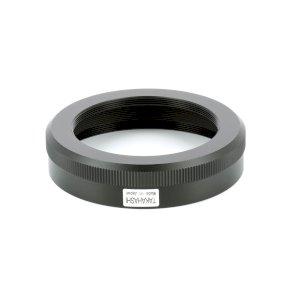
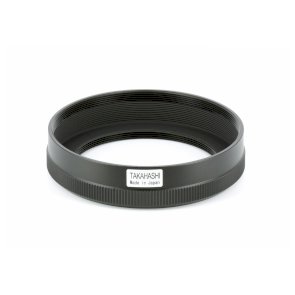
Takahashi's Coupling (TW), part TKP31003, is the ring that carries a telescope-side accessory train across to the Wide Mount T-ring camera system. Takahashi publishes a 22.5 mm light path for it — the length it contributes to your optical train, not the length you would measure across the part on a bench. On the system charts it is no. 8, a step away from the Wide T-mount entry it feeds.
Who It's For
This is a good match if you image through a Takahashi refractor and want your camera hanging off the Wide Mount T-ring system rather than the narrower standard T-thread.
Key Features & Design
- Coupling (TW) — Takahashi part TKP31003: no. 8 in Takahashi's system charts, where it links the telescope-side accessory chain to the Wide T-mount.
- 22.5 mm light path: Takahashi's published figure for what this coupling contributes to the optical train.
- Wide Mount camera side: it opens onto the DX-WR Wide Mount T-ring family, so the camera body attaches through the wider of Takahashi's two ring systems.
- Purely mechanical: no optical element, and no change to focal length or focal ratio.
Recommended Uses
- Prime-focus imaging with a Wide Mount T-ring on a Takahashi refractor.
- Rebuilding a camera train around the Wide Mount system after a change of camera body.
Compatibility and Accessory Notes
- 22.5 mm of the budget. Every flattener and reducer has a back focus target, and this coupling spends 22.5 mm of it, which is worth working out before the rest of the train is fixed. The Takahashi Back Focus Guide lists the figure alongside the back focus target for each Takahashi telescope.
- Wide Mount T-rings are the other half. The DX-WR rings for Canon EOS and Nikon carry the camera-side connection and are sold separately.
- There is a second version for the CCA-250. Takahashi lists that one as no. 8A, part TKP86003, at 34.2 mm — a different length for a different accessory family, so the two are not interchangeable.
Frequently Asked Questions
Is it difficult to set up?
No. It threads between two accessory families that were designed to meet here, and there is nothing to align or adjust once it is seated.
What does it add to my optical train?
22.5 mm, per Takahashi's published light path figure.
How is it different from the CCA-250 coupling?
That one is TKP86003, chart no. 8A, and it runs 34.2 mm. It belongs to the 98 mm CCA-250 accessory family rather than this one.
Does it include any optics?
No, it is a mechanical coupling only.
Bottom Line
Takahashi's no. 8 coupling: 22.5 mm of light path between a telescope-side accessory train and a Wide Mount T-ring. With the Wide Mount ring for your camera body, the connection is complete — and if you would like a second pair of eyes on the spacing, send us the rest of your train and we will work it out with you.
| Takahashi part number | TKP31003 |
|---|---|
| Type | Coupling (TW) |
| System chart no. | 8 |
| Light path | 22.5 mm |
| Camera side | Wide Mount T-ring system |
Shopping Guide
- Takahashi English Catalog 2025 — PDF, 8.63 MB
System Charts, Diagrams and Adapter Guides
- Takahashi Telescope Backfocus Table — PDF, 71 kB
You may also like
Recently viewed
Recent Blog Posts
View all
Your Guide Graph Is Lying to You
Read More

D-Size vs V-Size: A Complete Guide to Telescope Dovetail Systems
Read More

What Is Back Focus in Astrophotography? Telescope Reducers, Flatteners, and Spacing Explained
Read More