
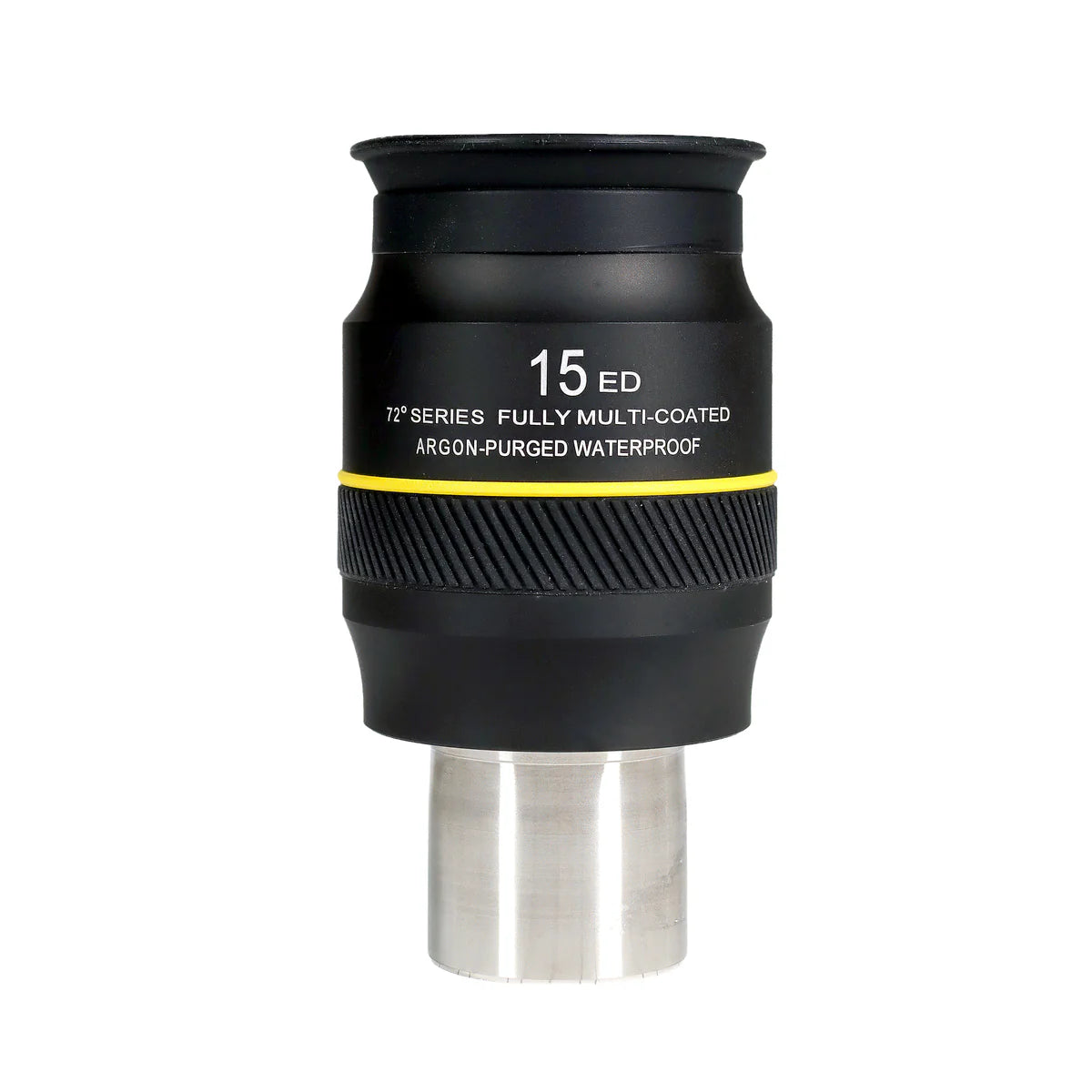

- Description
- Specifications
Product Overview
The Explore Scientific 72° ED Series 15mm is a medium-focal-length waterproof eyepiece on a 1.25-inch barrel, built around extra-low-dispersion glass. It presents a 72° apparent field, and Explore Scientific specifies generous eye relief for the series as a design goal rather than an afterthought.
At 15mm it lands in the most-used part of a focal-length set. In a 952mm refractor it gives 63x; in a 1200mm Schmidt-Cassegrain, 80x; in a 1500mm Maksutov, 100x; in a 480mm short refractor, 32x. That is the range where most deep-sky observing happens — high enough to darken the background sky and pull out structure, low enough that the exit pupil stays comfortable and the object still has room to breathe.
The 72° field sits between the 68° Series and the 82° Series. It is wide enough that an object at medium power drifts across the field slowly on an undriven mount, without asking the outer field to perform the way a 100° design does.
Who It's For
- Deep-sky observers working clusters and nebulae, where 15mm is often the single most productive focal length in the case.
- Dobsonian and undriven-mount users: a wider apparent field converts directly into more seconds on target between nudges.
- Eyeglass wearers: Explore Scientific builds generous eye relief into this series, which is the usual sticking point once focal lengths drop below 20mm.
- Observers who want colour fidelity: the ED glass is there to keep colour edges clean on bright stars and to hold contrast on planetary detail.
- Anyone observing in dew or damp air: the waterproof housing is consistent with the sealed construction used across the Explore Scientific waterproof eyepiece range.
Key Features & Design
- Extra-low-dispersion (ED) glass: reduces chromatic aberration generated inside the eyepiece itself, which shows up as cleaner colour separation on bright stars and better-held contrast on fine detail.
- 72° apparent field of view: a genuinely wide field that still keeps the outer zone well behaved, and one that suits both framing large objects and holding smaller ones in view.
- 15mm focal length: the workhorse power in most telescopes, and the one most observers reach for first on a deep-sky target.
- 1.25″ barrel: fits any standard 1.25-inch focuser or diagonal directly, with no adapter needed.
- Waterproof construction, in line with the sealed housings Explore Scientific uses across its waterproof eyepiece lines.
- Generous eye relief for the focal length, which keeps long sessions comfortable and makes observing with glasses on practical.
Recommended Uses
- Medium-power deep-sky observing — open clusters, globular clusters, emission and reflection nebulae, and the brighter galaxies.
- Lunar observing at moderate magnification, where the whole disc or a large region frames well.
- Observing on an undriven Dobsonian, where 72° of apparent field buys drift time.
- Observing with eyeglasses on, where the series' eye relief is the enabling factor.
- Filling the mid-power slot in a matched 72° ED set so the apparent field and eye position stay consistent as you change magnification.
Compatibility and Accessory Notes
- Fits any 1.25-inch focuser or diagonal. In a 2-inch focuser it seats in a 2-inch to 1.25-inch adapter, which we stock.
- Magnification: telescope focal length ÷ 15. A 750mm Newtonian gives 50x; a 1000mm telescope 67x; a 2000mm SCT 133x.
- Exit pupil: 15mm divided by your telescope's focal ratio. That is 2.5mm at f/6 and 1.5mm at f/10 — comfortable figures for extended deep-sky viewing.
- Filters: takes standard 1.25-inch threaded filters. At 15mm a UHC or O-III filter is the classic pairing for emission nebulae, and a broadband filter helps from a light-polluted site.
- Focal extenders: a 2x extender gives the magnification of a 7.5mm eyepiece while retaining the eye position and field character of the 15mm, which is a useful route to high power for eyeglass wearers.
- Within the series: the 72° ED Series spans several focal lengths, so a matched set holds the same apparent field and a similar eye position as you move through magnifications.
Good to Know Before You Order
- Explore Scientific does not currently publish a specification table for this eyepiece. Eye relief in millimetres, field stop diameter, element count, physical dimensions and weight are not given on their product page, so those rows appear below as unpublished rather than estimated. If you need a specific figure before ordering, ask us and we will put the question to our Explore Scientific rep.
- Without a published field stop, we cannot calculate your true field precisely. A reasonable working estimate comes from apparent field divided by magnification, but that is an approximation rather than a specification, so we leave the row blank rather than fill it.
- It is a visual eyepiece. Eyepiece-projection imaging is possible with the right adapter, but the design target here is the eye.
- 72° is wide, and wide fields ask for good eye placement. Taking in the whole field means holding your eye in the right position rather than pressing it to the lens — a habit that comes quickly and pays off across every wide-field eyepiece you own.
- ED glass addresses colour generated inside the eyepiece, not colour produced by your telescope's objective. In a fast achromatic refractor, the objective remains the dominant source of any fringing you see, and a minus-violet filter is the tool for that end of the problem.
Frequently Asked Questions
Is it difficult to set up?
No — it drops into any 1.25-inch focuser or diagonal and is ready immediately. Nothing to assemble, collimate or adjust.
What magnification will I get?
Divide your telescope's focal length in millimetres by 15. A 1200mm telescope gives 80x.
What does the ED glass actually change?
Extra-low-dispersion glass brings different wavelengths closer to a common focus inside the eyepiece, so colour edges around bright stars are cleaner and fine low-contrast detail holds up better than it does in a standard-glass design of the same field width.
Can I use it with glasses on?
Explore Scientific specifies generous eye relief for this series, which is what makes that practical. They do not publish the figure in millimetres, so we would rather not quote one — if it is the deciding factor, ask and we will confirm it with our rep first.
How wide a true field does it give?
That depends on the field stop diameter, which Explore Scientific does not publish for this eyepiece. Dividing the 72° apparent field by your magnification gives a close working figure, and we can get the exact number from our rep if you need it.
How does it compare with the 82° Series at the same focal length?
The 82° gives a wider, more immersive field; the 72° ED is built around glass type and eye relief instead, in a lighter and more compact body. Which suits you depends on whether field width or comfort and colour correction matters more in your observing — tell us how you observe and we will give you an honest answer.
Is it suitable for a Dobsonian?
Very much so. The wider apparent field is exactly what an undriven mount benefits from, since an object at 72° takes noticeably longer to cross the field than it would in a narrow-field eyepiece at the same magnification.
Bottom Line
In short: a 15mm ED-glass eyepiece with a 72° field, a 1.25-inch barrel and waterproof construction — the most-used magnification in most telescopes, with more field and more eye relief than the focal length usually brings. If you are building out a focal-length set for a particular telescope, send us its aperture and focal length and we will work out which of the series make sense together.
| Description | 15mm 72° ED Series Waterproof Eyepiece |
|---|---|
| Item Number | EPWP7215ED-01 |
| Focal Length | 15mm |
| Apparent Field of View | 72° |
| Barrel Size | 1.25-inch |
| Glass Type | Extra-low dispersion (ED) |
| Construction | Waterproof |
| Eye Relief | Not published by vendor |
| Field Stop Diameter | Not published by vendor |
| Element Count | Not published by vendor |
| Length | Not published by vendor |
| Width | Not published by vendor |
| Weight | Not published by vendor |
You may also like
Recently viewed
Recent Blog Posts
View all
Your Guide Graph Is Lying to You
Read More

D-Size vs V-Size: A Complete Guide to Telescope Dovetail Systems
Read More

What Is Back Focus in Astrophotography? Telescope Reducers, Flatteners, and Spacing Explained
Read More