

- Description
- Specifications
Product Overview
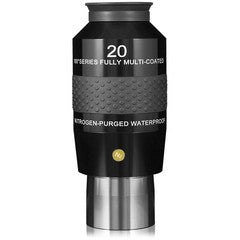
The Explore Scientific 100° Series 20mm is a large 2-inch waterproof eyepiece built around a 100-degree apparent field, with a published field stop of 34.8mm and 14.5mm of eye relief. The body is 156mm long and 70mm wide, and Explore Scientific's current figure for its weight is 916 g.
The 34.8mm field stop is close to the practical limit of what a 2-inch barrel can pass, which is what makes this eyepiece interesting: at 20mm it combines a wide true field with enough magnification to darken the sky background. In a 714mm refractor that works out to 36x over 2.79°; in a 1000mm telescope, 50x over 1.99°; in a 1200mm Schmidt-Cassegrain, 60x over 1.66°.
The optics are fully multi-coated and edge-blackened, and the housing is gas-purged and tested to one metre of submersion for thirty minutes.
Who It's For
- Deep-sky observers chasing large objects: the North America Nebula, the Veil, the Heart and Soul complexes and the largest open clusters all fit inside a 2.79° field in a short-focus telescope.
- Observers who want the spacewalk view: at 100 degrees the field edge sits outside the eye's normal attention, so there is no sense of looking down a tube.
- Dobsonian and undriven-mount users: more apparent field means more drift time between nudges, and at 100° that is a substantial gain.
- Observers who want one eyepiece to do the low-power work: at 20mm this covers finding, framing and sweeping in a single ocular.
- Damp-site observers: the sealed, gas-purged housing and the 1 metre / 30 minute submersion test are built for weather that ends other sessions.
Key Features & Design
- 100° apparent field of view: the widest apparent field Explore Scientific offers, which is what produces the impression of an unframed view.
- 34.8mm field stop: a published figure near the ceiling for a 2-inch barrel, and the number that fixes the true field precisely.
- 14.5mm eye relief, notably generous for a 100-degree design where eye relief is usually the hardest constraint.
- Fully multi-coated and edge-blackened elements: the coatings raise transmission and the blackened edges suppress the internal reflections that a large, many-element eyepiece is otherwise prone to.
- Gas-purged sealed housing, submersion tested to 1 metre for 30 minutes.
- 2-inch barrel accepting standard 2-inch threaded filters.
- Published dimensions: 156mm long, 70mm wide, 916 g on the current Explore Scientific spec sheet.
Recommended Uses
- Wide-field deep-sky observing of large nebulae, star clouds and open clusters.
- Low-power sweeping of the Milky Way, where 100 degrees of field is at its most striking.
- Finding and framing before switching to higher power on the same target.
- Nebula-filter observing, where the wide true field and a 2-inch narrowband filter work together.
- Long sessions on an undriven mount, where the apparent field keeps objects in view.
Compatibility and Accessory Notes
- Requires a 2-inch focuser or diagonal with enough clearance for a 156mm long, 70mm wide body. Tell us your focuser and diagonal and we will check the clearance with you.
- Magnification: telescope focal length ÷ 20. A 714mm refractor gives 36x, a 1000mm gives 50x, a 1200mm SCT gives 60x, a 1500mm Maksutov gives 75x.
- True field: 34.8 ÷ focal length × 57.3. That is 2.79° at 714mm, 1.99° at 1000mm, 1.66° at 1200mm.
- Exit pupil: 20mm divided by the telescope's focal ratio — 4.0mm at f/5, 2.9mm at f/7, 2.0mm at f/10. All comfortable sizes for a dark-adapted eye.
- Filters: standard 2-inch threaded filters. A broadband or narrowband nebula filter is the natural companion given the field size.
- Balance: 916 g is a substantial mass at the focuser. Magnetic balance weights or a counterweight bar settle a Dobsonian that tips with it in place, and we stock both.
Good to Know Before You Order
- This is a large, heavy eyepiece. 156mm long, 70mm wide and 916 g is enough to unbalance a lightly loaded Dobsonian or a small refractor on a photo tripod. Balance weights fix it, and we can include one with the order.
- Explore Scientific has published two weight and purge figures across revisions. The current sheet for item EPWP10020-01 lists 916 g and describes the housing as argon-purged; an earlier sheet for item EPWP10020-00 listed 968 g and described it as nitrogen-purged. Both are shown as published rather than reconciled into one number.
- A focuser needs clearance for the body. At 70mm wide the eyepiece can foul a finder bracket or a low-profile focuser on some telescopes. Send us your telescope model and we will check it before you order.
- A 100° field asks the eye to travel. Seeing the whole field means looking around it, and the outer few degrees sit beyond where the eye naturally rests. That is what the design is for rather than a shortcoming.
- The submersion rating covers immersion, not use underwater. 1 metre for 30 minutes is there so heavy dew, rain and a drop in wet grass are non-events.
- Explore Scientific does not publish an element count for this eyepiece, so that row is absent below rather than estimated.
Frequently Asked Questions
Is it difficult to set up?
No — it slides into any 2-inch focuser or diagonal and is ready to observe with. The only thing worth a moment's thought is balance: at 916 g it may shift a light telescope enough to want a counterweight.
What true field will I get?
Divide 34.8 by your telescope's focal length in millimetres and multiply by 57.3. A 1000mm telescope gives 1.99°; a 1500mm gives 1.33°.
Does the 100-degree field really look different?
Yes, distinctly. At 82° the field edge is still within peripheral awareness; at 100° it falls outside it, so the view reads as sky rather than as a circle. It is the single most-remarked difference between the two series.
Can I use a nebula filter with it?
Yes. Standard 2-inch threaded filters thread into the barrel, and a wide true field is exactly where narrowband filters show their value on large emission nebulae.
Will it balance on my Dobsonian?
It depends on the telescope and what else is on the tube. 916 g at the focuser is enough to tip a light Dob forward, and magnetic weights on the lower tube correct it. Tell us the model and we will give you a straight answer.
How much eye relief is there?
14.5mm, which is generous for a 100-degree design and enough that most observers find long sessions comfortable.
Bottom Line
In short: a 20mm eyepiece with a 100° apparent field, a 34.8mm field stop, 14.5mm of eye relief and a sealed 2-inch body tested to 1 metre for 30 minutes — the widest true field this focal length can deliver through a 2-inch barrel. If you would like the exact true field and exit pupil for the telescope you own, send us its aperture and focal length and we will work them out with you.
| Item Number | EPWP10020-01 |
|---|---|
| Description | 20mm 100° Series Waterproof Eyepiece |
| Focal Length | 20mm |
| Apparent Field of View | 100° |
| Field Stop Diameter | 34.8mm |
| Eye Relief | 14.5mm |
| Barrel Size | 2.00" |
| Length | 156mm |
| Width | 70mm |
| Weight | 916g (earlier EPWP10020-00 sheet: 38.1oz; 968g) |
| Waterproof | Yes — submersion tested to 1 metre for 30 minutes |
| Gas Purge | Argon (current sheet); nitrogen on earlier EPWP10020-00 sheet |
| Coatings | Fully multi-coated, edge-blackened elements |
| Filter Thread | Standard 2-inch |
| Element Count | Not published by vendor |
You may also like
Recently viewed
Recent Blog Posts
View all
Your Guide Graph Is Lying to You
Read More

D-Size vs V-Size: A Complete Guide to Telescope Dovetail Systems
Read More

What Is Back Focus in Astrophotography? Telescope Reducers, Flatteners, and Spacing Explained
Read More