
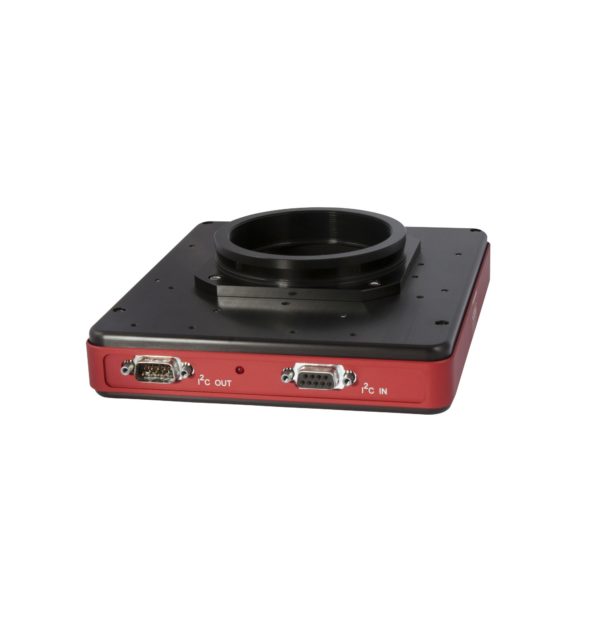

- Description
The next-generation of adaptive optics for our SBIG large-format cameras. Requires a StarChaser SC-3 guide camera (or an older self-guiding system).
The SBIG AO-X is a large aperture AO designed to be compatible with all large format SBIG cameras. It requires an off-axis guide camera behind the AO; typically the StarChaser SC-3 is used.
The AO-X is compatible with the Aluma AC4040, Aluma AC2020, and Aluma AC455 cameras, when used with a StarChaser SC-3.
AO-X is also compatible with older STX-16803, STXL-16200, STXL-11000, and STXL-6303 cameras. Guiding can be performed via a StarChaser SC-3, or through older guide systems including STX Guider, FW8G-STXL self-guided filter wheels, the built-in guide sensor on some STX cameras, or a Remote Guide Head with an off-axis guider behind the AO-X.
AO Results:
The images below are actual star images showing the effect of image wander corrected at 1 Hz and 10 Hz:
 1 Hz Corrections
 10 Hz Corrections
And the resulting size of the star image in a long exposure:
 1 Hz Corrections
 10 Hz Corrections
Other data gathered by Brad Wallis of JPL (Brad Wallis and Benoit Schillings developed the prototype for the original AO-7) show the the effect of rapid corrections on poor seeing. At 1 Hz the larger, slower component is reduced, but the amplitude of the jitter remains about the same:

However, at a 5Hz correction rate, the faster jitter is reduced:

And at a 10 Hz correction rate, significant improvement is seen:

The improvement in stellar profiles can also be seen at corrections above 1 Hz. First by looking at the non-AO guided image:

And comparing the non-AO guided image to the AO guided image there is again significant improvement in the FWHM of the star profile:

Telescope mounts cannot correct faster than about once per second. The 10Hz rate of the AO-X will clearly result in improved resolution under the right conditions.
SPECIFICATIONS:
| Power |
Supplied through Camera’s I2C Port |
|---|---|
| OS Compatibility |
Windows 32 and 64 bit OS, Mac |
| Computer Interface |
I2C |
| Dimensions |
6 x 7 x 1.2 in. |
| Weight |
2.2 lbs (1 kg) |
You may also like
Recently viewed
Recent Blog Posts
View all
Your Guide Graph Is Lying to You
Read More

D-Size vs V-Size: A Complete Guide to Telescope Dovetail Systems
Read More

What Is Back Focus in Astrophotography? Telescope Reducers, Flatteners, and Spacing Explained
Read More