

- Description
- Specifications
Two exciting new Alt-Az strain wave mounts, HAZ31 and HAZ46, are added into iOptron strain wave gear mount family!
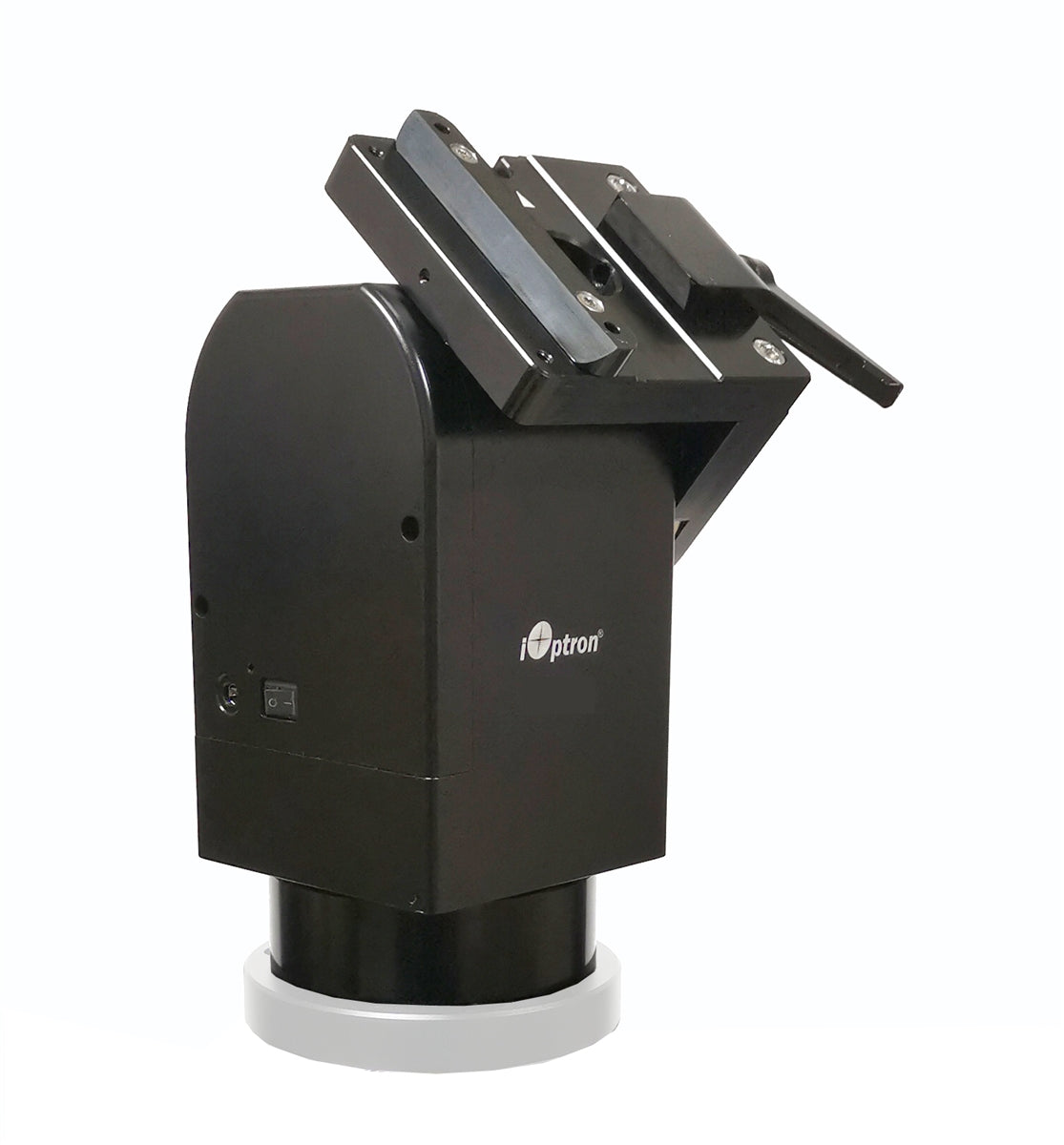
This light weight, compact, medium payload HAZ31 mount will deliver an astronomy experience like never before. With a mount head weighing in at 8.2 lbs, HAZ31 has a payload capability 31 lbs, without needing a cumbersome counterweight or shaft. HAZ mounts will support a large variety of instruments where flexibility is needed for outreach programs and satellite tracking. The multi position saddle (can be placed on top or to the side) uniquely setting up the HAZ31 to accommodate binoculars. Just turn the mount on, it will calibrate itself and GoTo the first target utilizing our time tested "Lever and Go" technology.
Utilizing state of the art strain wave gear technology for both RA and DEC movement, the HAZ31 deliver unparalleled weight to payload efficiency. Its black anodized all metal CNC machined body is not only appealing to the eye, it’s a rugged platform that will perform at the highest level for many years to come. Unique features such as an electronic friction brake on both ALT and AZI allows the mount safely stop.
An HAZ31 mount can be controlled by a computer, either via ASCOM/Commander for a Windows PC or a third party INDI driver for a MacOS software; a SmartPhone/Tablet via iOptron Commander Lite or an App like SkySafari; or a Raspberry Pi device via INDI driver.
(Actual contents may differ from the image)
 |
|
|  | |||||||||||||||||||||||||||||||||||||||||||||||||||||
 |
You may also like
Recently viewed
Recent Blog Posts
View all
Your Guide Graph Is Lying to You
You drove ninety minutes to dark sky, PHD2 held 0.4 arcseconds all night, and half your subs still have eggs for stars. Here are the three things your
Read More
Read More

D-Size vs V-Size: A Complete Guide to Telescope Dovetail Systems
What's the difference between D-size and V-size telescope dovetails? Here's everything you need to know.
Read More
Read More

What Is Back Focus in Astrophotography? Telescope Reducers, Flatteners, and Spacing Explained
What Is Back Focus in Astrophotography? Telescope Reducers, Flatteners, and Spacing Explained
Back focus is one of those astrophotography terms that c
Read More
Read More