
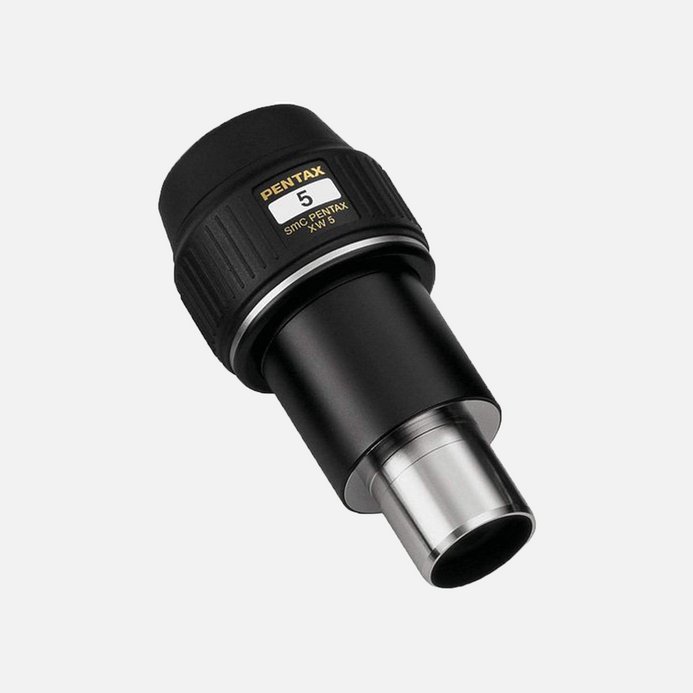

- Description
All of our eyepieces are constructed with a high-refraction, low-dispersion lanthanum glass that consistently delivers bright, high-resolution images with minimal distortion. In addition, all XW series eyepieces are built to JIS Class 4 weather-proof standards which increases their durability in less than ideal conditions. Designed for use with a wide range of telescopes and PENTAX brand spotting scopes, the XW series eyepieces are a clear choice for ground and astronomical applications.
Compatible with the PF-65 and PF-65 ED II series spotting scopes, PF-80 series spotting scopes, PF-100 series spotting scopes.
 |
 |
| Beschreibung | XW5 |
| Focal Length | 5mm |
| Lens construction [Elements/Groups] |
8/6 |
| Eye Relief Figures in parentheses are the distance from the viewing rubber |
20mm(15mm) |
| Apparent Angle of View | 70° |
| Coating* | Multi coating |
| Weatherproof | JIS class 4 equivalent (splash-proof) |
| Sleeve size | 31.7mm |
| Diameter & Length (minimum) | 127 x 61mm |
| Weight (+/- 5%) | 395g |
| Accessories | Eyepiece lens cap, Objective lens cap |
You may also like
Recently viewed
Recent Blog Posts
View all
Your Guide Graph Is Lying to You
You drove ninety minutes to dark sky, PHD2 held 0.4 arcseconds all night, and half your subs still have eggs for stars. Here are the three things your
Read More
Read More

D-Size vs V-Size: A Complete Guide to Telescope Dovetail Systems
What's the difference between D-size and V-size telescope dovetails? Here's everything you need to know.
Read More
Read More

What Is Back Focus in Astrophotography? Telescope Reducers, Flatteners, and Spacing Explained
What Is Back Focus in Astrophotography? Telescope Reducers, Flatteners, and Spacing Explained
Back focus is one of those astrophotography terms that c
Read More
Read More