

- Description
- Specifications
Product overview
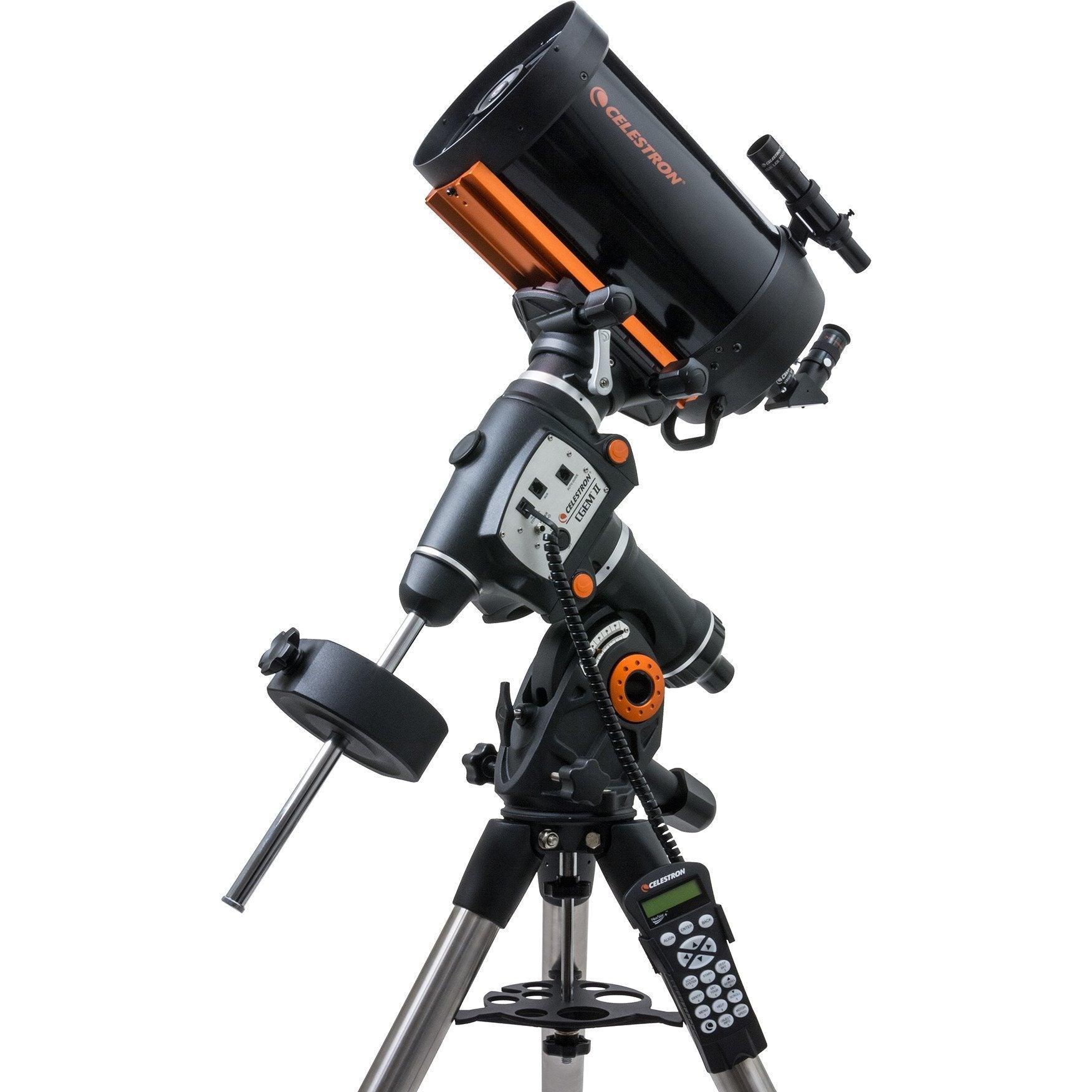
The Celestron CGEM II 800 Schmidt-Cassegrain Telescope pairs an 8-inch Celestron SCT optical tube with the CGEM II computerized German equatorial mount. It is a capable GoTo telescope package for visual observing, lunar and planetary imaging, and intermediate deep-sky astrophotography.
Who Is This Product Best For?
This system is best for intermediate astronomers who want a versatile 8-inch telescope with a stronger mount than smaller entry-level packages. It suits visual observers, planetary imagers, and astrophotographers who want a long focal length SCT platform.
Why Choose This Product?
- 8-inch Schmidt-Cassegrain optical tube provides strong light gathering in a compact design.
- 2032mm focal length is useful for planets, the Moon, galaxies, and compact deep-sky objects.
- CGEM II mount offers GoTo tracking, autoguider support, and a solid equatorial imaging platform.
- StarBright XLT coatings support good visual contrast and imaging throughput.
- A versatile telescope package for both visual observing and imaging.
Recommended Uses
- Lunar and planetary observing
- Planetary imaging
- Visual deep-sky observing
- Small galaxy and planetary nebula imaging
- Backyard or semi-portable GoTo setups
Compatibility and Accessory Notes
Use appropriate SCT adapters, a camera, guide system, and power supply for imaging. A focal reducer can be useful for wider-field imaging, while Barlows are useful for planetary imaging.
Important Limitations
Long focal length deep-sky imaging requires accurate polar alignment, guiding, and careful balance. This is not the easiest first astrophotography telescope for wide-field targets.
Frequently Asked Questions
Is this good for beginners?
It is manageable for a motivated beginner, but best for intermediate users.
What is it best used for?
It is best for lunar, planetary, and compact deep-sky observing or imaging.
Is it for visual observing or astrophotography?
Both, with accessories required for astrophotography.
Does it require additional accessories?
Imaging requires a camera, adapters, guiding equipment, and stable power.
When should it not be recommended?
Do not choose it as a simple wide-field beginner imaging rig.
Our Recommendation
Ontario Telescope recommends this package for customers who want a strong 8-inch SCT on a capable mount. Choose it for flexibility; choose a shorter focal length refractor or astrograph for easier wide-field imaging.
| Product Type | Computerized Schmidt-Cassegrain telescope package |
|---|---|
| SKU | 12010 |
| Aperture | 203 mm / 8 in |
| Focal Length | 2032 mm |
| Focal Ratio | f/10 |
| Optical Design | Schmidt-Cassegrain |
| Mount | CGEM II computerized German equatorial mount |
| Primary Use | Visual observing, planetary imaging, compact deep-sky imaging |
| Important Note | Long focal length imaging requires accurate polar alignment, guiding, and careful balance. |
You may also like
Recently viewed
Recent Blog Posts
View all
Your Guide Graph Is Lying to You
Read More

D-Size vs V-Size: A Complete Guide to Telescope Dovetail Systems
Read More

What Is Back Focus in Astrophotography? Telescope Reducers, Flatteners, and Spacing Explained
Read More