
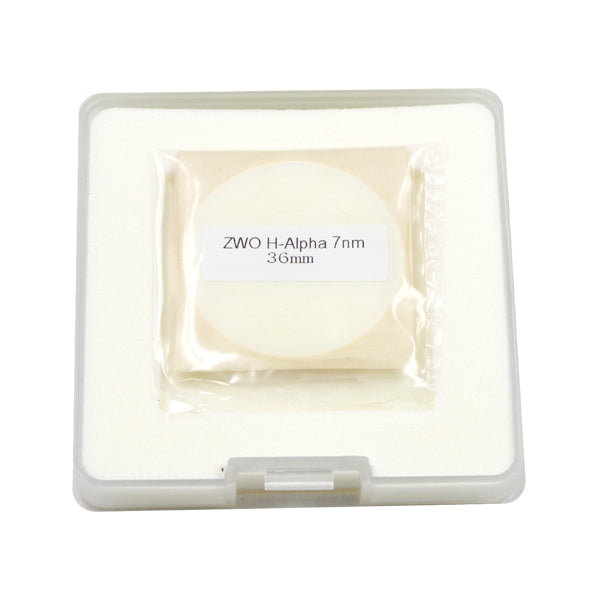


- Description
- Specifications
Product Overview
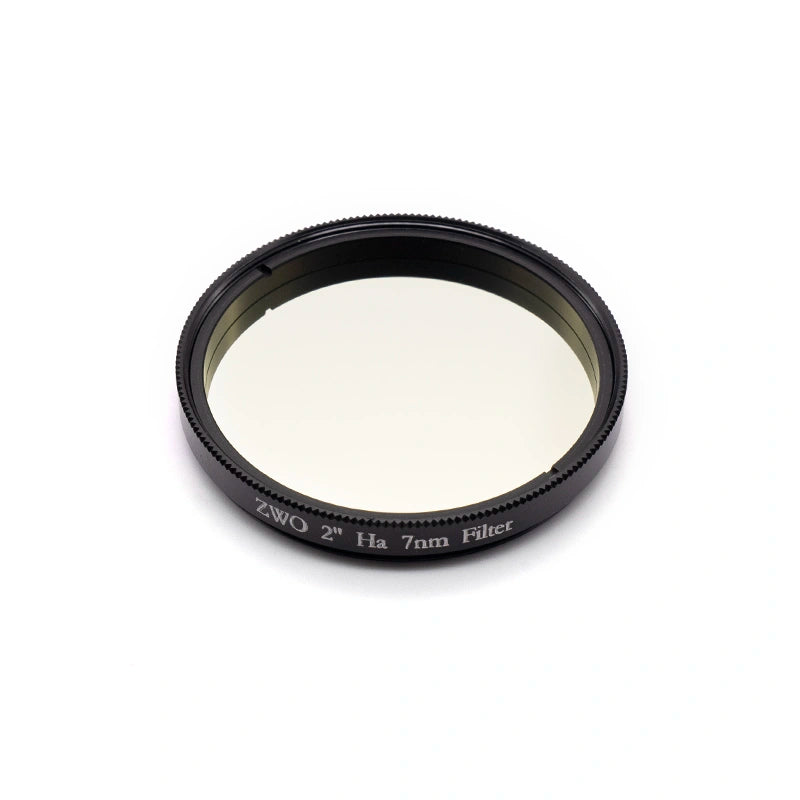
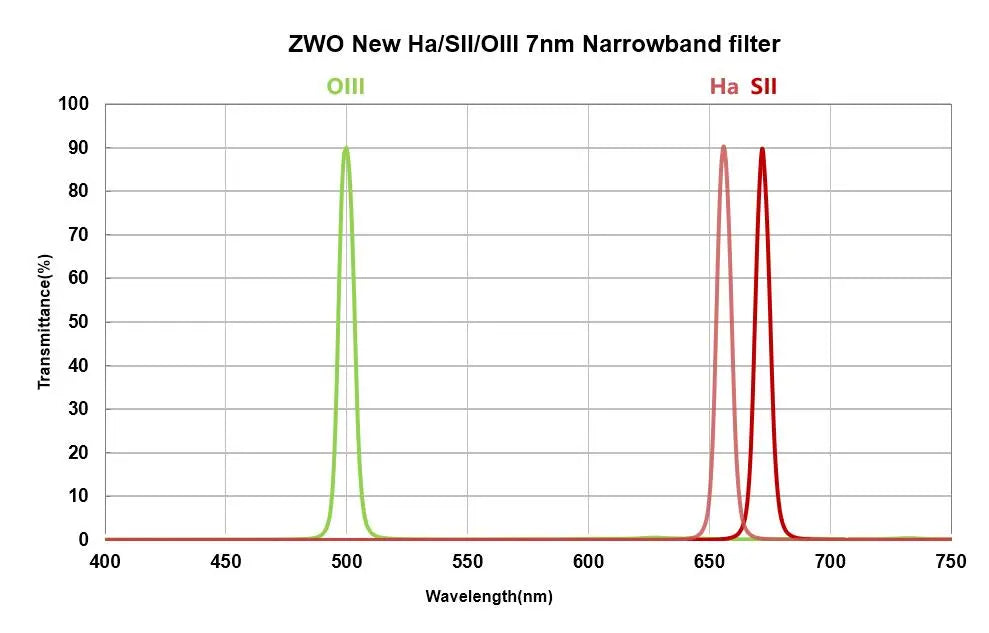
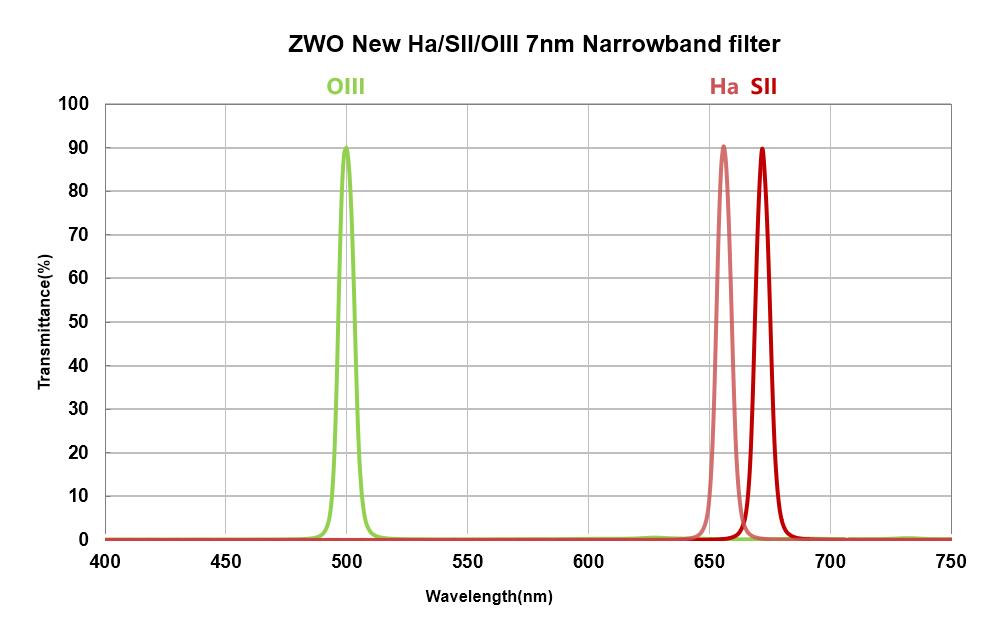
The ZWO H-alpha 7nm Narrowband Filter passes a 7 nm band centred on the hydrogen-alpha line at 656 nm and rejects effectively everything else. Peak transmission is around 90%, off-band rejection is OD3 (below 0.1%), and infrared from 700–1100 nm is cut. Every size is polished to 1/4 wavefront on both surfaces.
Available in three sizes — 1.25" mounted, 36 mm unmounted, and 2" mounted. Each is a single filter, not a set. Which one you need is decided by your sensor, not your telescope — see the sizing guidance below before ordering.
Choosing the Right Size
This is the only decision that really matters here, and it is the one most often got wrong. A filter too small for your sensor vignettes the corners, and no amount of processing recovers it — the cell wall is a physical obstruction.
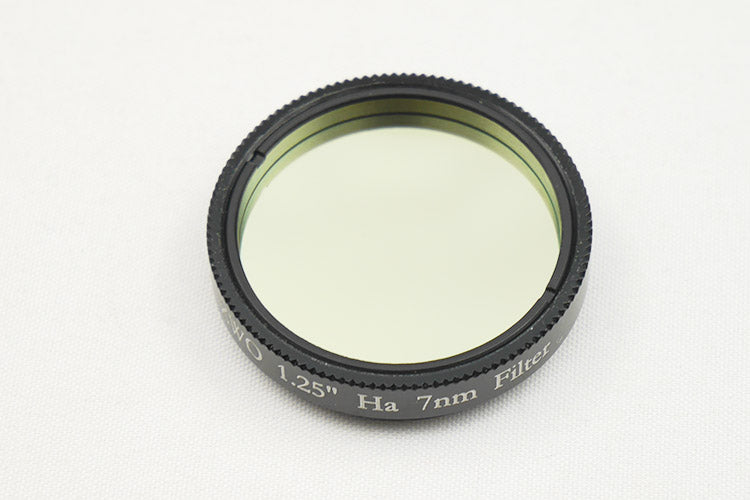
- 1.25" mounted — for sensors up to about 4/3": ASI1600, ASI294, ASI533 and similar. Threaded cell, fits 1.25" filter wheels and any standard 1.25" thread. 1.9 mm glass. Will vignette APS-C and full-frame
- 36 mm unmounted — for APS-C and smaller: ASI2600MM, ASI294MM and similar. Bare glass, no cell and no thread, so the full 36 mm is clear aperture. Fits the ZWO 36 mm EFW (7×36 mm). 2 mm glass. Will not cover full-frame
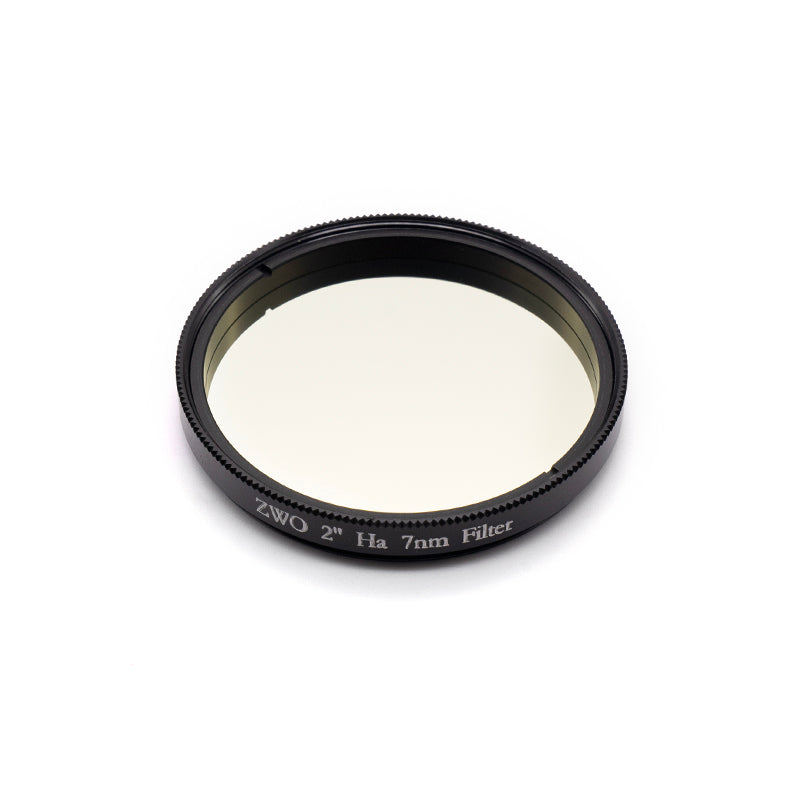
- 2" mounted — for sensors up to full-frame: ASI6200MM, ASI2400 and similar. Threaded cell, fits 2" filter wheels, drawers, and any standard 2" (M48) thread
If you are between sizes, size up. The cost difference is far smaller than the cost of re-buying.
Who It's For
This is a good match if you image emission nebulae with a monochrome camera from a light-polluted site. A 7 nm passband rejects mercury vapour, sodium vapour, and atmospheric skyglow almost entirely — which is why narrowband work is productive on nights when broadband imaging is not, including with the Moon up.
It is also the standard first step beyond LRGB: blending a mono H-alpha channel into RGB data sharpens nebular structure while keeping colour natural. H-alpha is the filter most imagers buy first, because it is where emission nebulae are brightest and where narrowband beats broadband by the widest margin.
Key Features & Design
- 656 nm centre wavelength, 7 nm bandpass: targets the hydrogen-alpha emission line where most nebulae radiate strongest
- FWHM 7 ± 0.5 nm: a tight, specified passband rather than a nominal figure
- Approximately 90% peak transmission at the H-alpha line, with 80% as the floor
- OD3 off-band blocking: under 0.1% transmission outside the passband — this is what kills light pollution
- IR cut from 700–1100 nm: keeps infrared from bloating stars, so no separate UV/IR-cut filter is needed behind it
- 1/4 wavefront both surfaces: fine-polished, so the filter does not degrade star shapes in a converging beam
- Three sizes: 1.25" mounted (1.9 mm glass), 36 mm unmounted (2 mm), and 2" mounted
Recommended Uses
- Emission nebulae — Orion, Lagoon, Eagle, North America, Rosette
- Planetary nebulae and supernova remnants — the Ring, Dumbbell, Helix, and the Veil
- SHO / Hubble-palette imaging combined with the matching S-II and O-III 7 nm filters
- Ha-enhanced LRGB, blending H-alpha into RGB to lift structural detail without shifting colour
- Imaging under moonlight or heavy light pollution, where broadband work is not viable
Compatibility and Accessory Notes
- Monochrome cameras only. A one-shot-colour camera or DSLR has a Bayer matrix, so only the red-sensitive pixels see H-alpha — you lose most of your resolution and most of your light
- 36 mm is unmounted: no cell and no thread. It cannot be screwed into a filter drawer or nosepiece — it is retained by M2 screws in a filter wheel recess, and those screws ship with the ZWO 36 mm EFW
- 1.25" and 2" are mounted: threaded cells that fit filter wheels, drawers, and standard filter threads
- Third-party wheels: ZWO specifies filter thickness between 1.5 mm and 3.0 mm for its wheels
- Orientation: ZWO advises that on the current Mark II filters the coated side should face the telescope
- Backfocus: glass in a converging beam shifts focus by roughly one third of its thickness — about 0.6–0.7 mm here. Include it in your 55 mm sum, and use the same thickness in every wheel slot so focus does not shift between channels
- Sold singly. For all three channels, the S-II and O-III filters are separate products, or buy the 2" SHO set
Important Limitations
- Not for one-shot-colour cameras or DSLRs. This is a monochrome imaging filter. On a colour sensor the Bayer matrix wastes most of the signal
- Size must match your sensor. 1.25" vignettes APS-C and full-frame; 36 mm will not cover full-frame. This is a physical obstruction, not a coating issue
- Unmounted 36 mm glass must be handled by the edges. There is no cell protecting the coating, and a fingerprint on a narrowband coating is a real problem
- Narrowband does not brighten nebulae — it raises contrast by darkening the sky. Expect longer sub-exposures, not brighter ones
- Not a general light-pollution filter. It passes one 7 nm band. Stars and galaxies, which emit broadband, largely disappear
- Not for visual observing. A 7 nm H-alpha band is far too dark for the eye
- A filter wheel and monochrome camera are required and sold separately
Frequently Asked Questions
Which size do I need?
Match it to your sensor, not your telescope. Up to about 4/3" (ASI1600, ASI294, ASI533), the 1.25" is fine. APS-C and smaller (ASI2600MM), the 36 mm unmounted. Up to full-frame (ASI6200MM), the 2". Buying 1.25" for an APS-C camera vignettes the corners permanently.
What is the difference between mounted and unmounted?
A mounted filter sits in a threaded cell you can screw into things. An unmounted filter is bare glass held by screws in a filter wheel. The 36 mm is unmounted precisely because a cell has walls, and walls block the corners of a big sensor.
Is this good for beginners?
It is a sound first narrowband filter if you already have a monochrome camera and a filter wheel. If you image with a one-shot-colour camera, this is not your next purchase — a dual-band filter is.
Will it work with my ASI2600MC or my DSLR?
Not effectively. Those are colour sensors. Only the red pixels respond to H-alpha, so you throw away roughly three quarters of your resolution. Use a mono camera, or a duo-band filter designed for colour sensors.
Why is my H-alpha image so dark?
That is the filter working. It rejects over 99.9% of the spectrum. Narrowband raises contrast by darkening the background, not by brightening the target — so plan on longer subs.
Can I image with the Moon up?
Yes, and that is much of the point. A 7 nm passband rejects moonlight and light pollution well enough that narrowband nights are the ones a broadband imager writes off.
Which way round does it go?
ZWO advises that on the Mark II filters the coated side should face the telescope.
Do I need a UV/IR-cut filter as well?
No. This filter cuts 700–1100 nm itself, so infrared will not bloat your stars through it.
Does it change my backfocus?
Slightly. Glass shifts focus by roughly a third of its thickness — about 0.6–0.7 mm depending on size. What matters more is using the same thickness across every wheel slot so focus does not jump between channels.
What do I need for the Hubble palette?
All three: this H-alpha, plus the S-II 7 nm at 672 nm and the O-III 7 nm at 500 nm. Map them to R, G, and B in processing.
Is one filter included, or three?
One. Each size option is a single H-alpha filter. The S-II and O-III are separate products.
Bottom Line
In short: a 7 nm H-alpha filter at 656 nm with roughly 90% peak transmission, OD3 blocking, and 1/4 wavefront polish — the first narrowband filter most mono imagers buy, and the one that makes light-polluted and moonlit nights productive. Pick the size from your sensor: 4/3" takes 1.25", APS-C takes 36 mm, full-frame takes 2".
| Type | Narrowband H-alpha imaging filter |
|---|---|
| Sizes available | 1.25" mounted · 36 mm unmounted · 2" mounted |
| Centre wavelength | 656 nm (hydrogen-alpha) |
| Bandpass | 7 nm |
| FWHM | 7 ± 0.5 nm |
| Peak transmission | Approx. 90% at 656 nm (80% minimum) |
| Off-band blocking | OD3 — below 0.1% transmission |
| Infrared cut | 700–1100 nm |
| Surface accuracy | 1/4 wavefront, both surfaces, fine-polished |
| Glass thickness | 1.9 mm (1.25") · 2 mm (36 mm) |
| Orientation | Coated side faces the telescope (Mark II) |
| Sensor coverage — 1.25" | Up to approx. 4/3" — vignettes APS-C and full-frame |
| Sensor coverage — 36 mm | APS-C and smaller — will not cover full-frame |
| Sensor coverage — 2" | Up to full-frame |
| Mounting — 1.25" / 2" | Threaded cell; fits filter wheels, drawers, standard threads |
| Mounting — 36 mm | Unmounted; retained by M2 screws in a filter wheel (screws supplied with ZWO 36 mm EFW) |
| Camera type | Monochrome only — not for OSC or DSLR |
| Quantity | Single filter per size option |
| Weight | Not provided by vendor |
| Recommended use | Emission nebulae, SHO narrowband, Ha-enhanced LRGB, light-polluted and moonlit skies |
You may also like
Recently viewed
Recent Blog Posts
View all
Your Guide Graph Is Lying to You
Read More
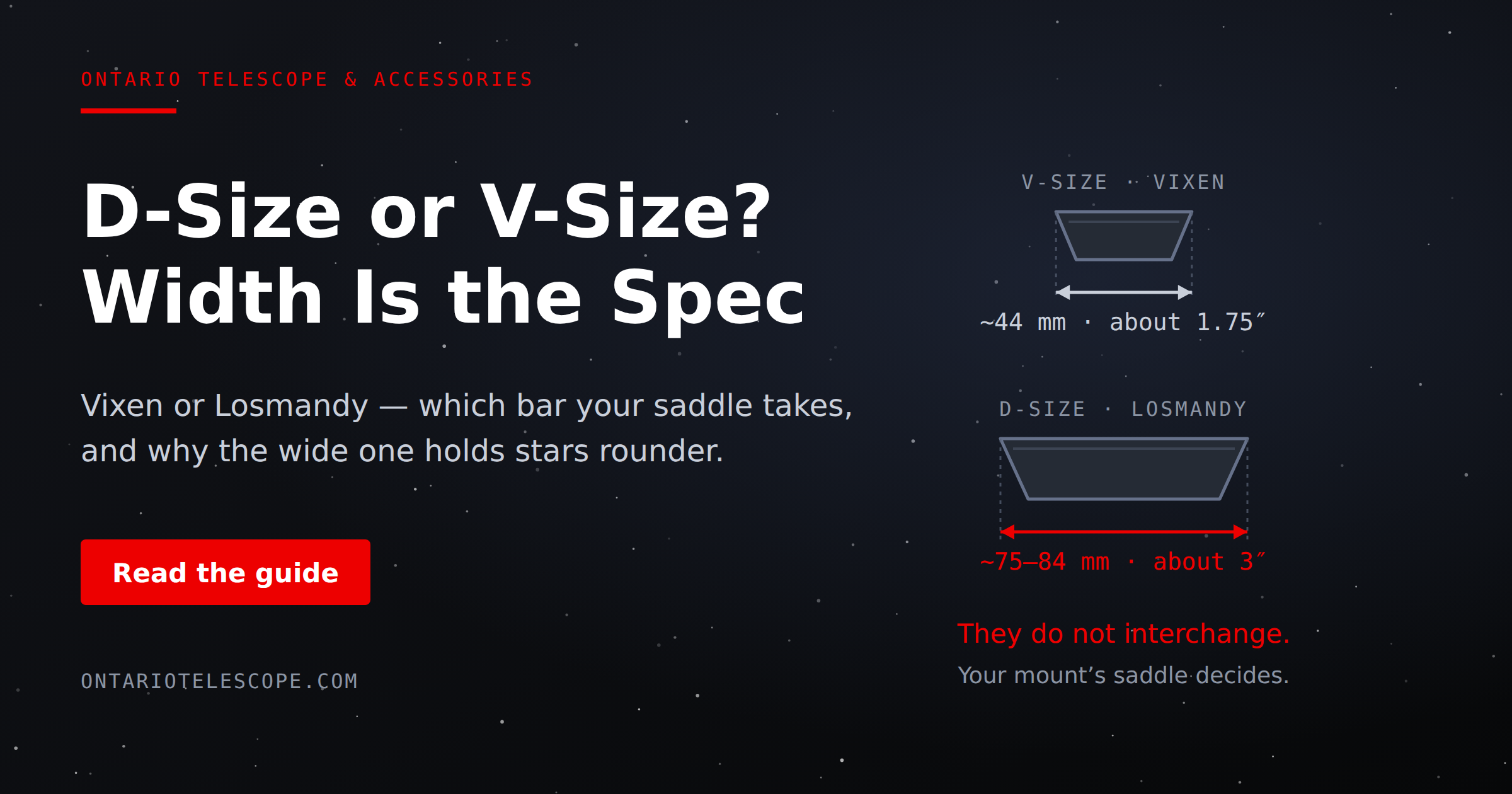
D-Size vs V-Size: A Complete Guide to Telescope Dovetail Systems
Read More
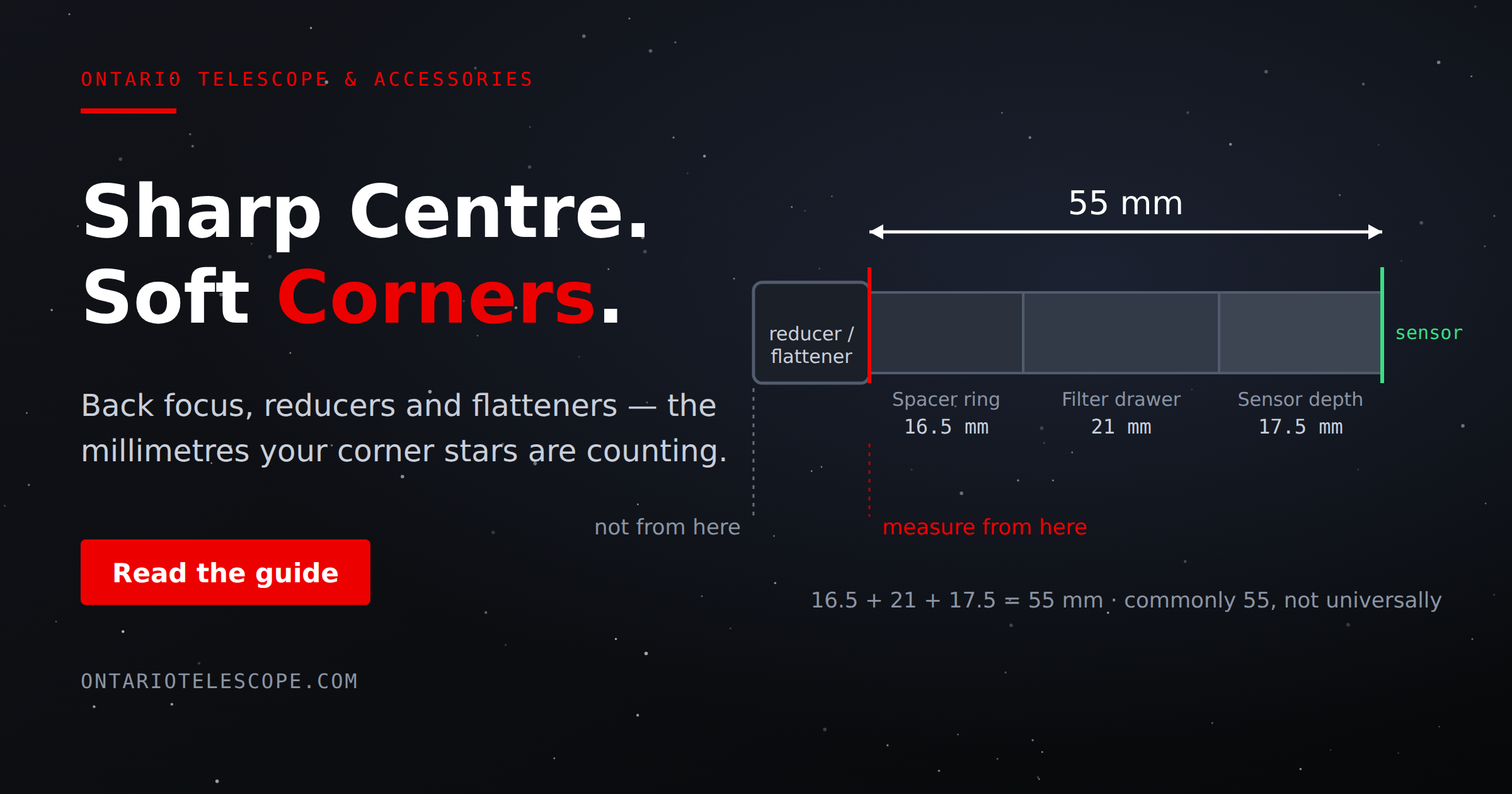
What Is Back Focus in Astrophotography? Telescope Reducers, Flatteners, and Spacing Explained
Read More