


- Description
- Specifications

Product Overview
The ZWO ASI461MM Pro is a medium-format cooled monochrome astronomy camera built around Sony's back-illuminated IMX461ALR-C CMOS sensor. At 44 × 33 mm it carries roughly 70% more imaging area than a full-frame sensor, resolving 11656 × 8750 — 101.99 megapixels — on a 3.76 µm pixel. A native 16-bit ADC, two-stage TEC cooling to 35 °C below ambient, and zero amp-glow circuitry place this at the top of ZWO's deep-sky camera line.
This is one of the largest sensors available to amateur astrophotographers, and it is unforgiving of optics that cannot cover it. Read the compatibility notes below before you buy.
Who It's For
This is a good match if you are imaging large nebulae, sprawling star fields, or extended galactic structure and want to avoid stitching mosaics. The 44 × 33 mm sensor demands optics with an image circle to match — a telescope corrected only for APS-C will vignette badly at these dimensions.
It is also a sound choice if you are doing photometry or scientific research, where 16-bit linearity, 1.0 e⁻ read noise, and a 50.3 ke⁻ full well matter more than frame rate.
It is not a planetary camera. At 3.77 fps at full resolution, high-frame-rate lucky imaging of Jupiter or the Moon is outside its purpose — use a ZWO planetary camera for that.
Key Features & Design
- Sony IMX461ALR-C, 44 × 33 mm medium format: back-illuminated CMOS at 3.76 µm pixel pitch, 101.99 MP (11656 × 8750), with a 55 mm sensor diagonal
- Native 16-bit ADC: 65,536 levels, holding tonal separation that a 12- or 14-bit camera cannot
- 50.3 ke⁻ full well capacity: rises to 198 ke⁻ in Bin2 mode with an effective 7.5 µm pixel — useful headroom against saturated star cores
- 1.0 e⁻ read noise: HCG mode engages automatically at gain 100 and drops read noise from roughly 3.1 e⁻ to under 1.5 e⁻ with no meaningful loss of dynamic range
- Two-stage TEC cooling: 35 °C below ambient, measured at 30 °C ambient temperature
- Zero amp glow: no infrared bloom in uncalibrated corners, even at high gain on long sub-exposures
- Polyimide dew heater: approximately 5 W on the protective window, switchable off in software to conserve power
- USB 3.0 Type-B with 256 MB DDR3 buffer: 3.77 fps at full resolution with no dropped frames during long reads
- 91% peak quantum efficiency: meaningfully shortens narrowband integration time
- Exposure range 32 µs to 2000 s: rolling shutter, AR-coated D79.3-4 protective window
Optical / Mechanical Design
At 3.76 µm across a 44 × 33 mm chip, the ASI461MM Pro is sampling-hungry rather than fast. Its 55 mm sensor diagonal exceeds the corrected image circle of most field flatteners, which means corner star quality on this camera is set by your optics, not by the camera. Verify your corrected image circle before committing — a scope advertised as full-frame capable will still fall off in the corners here.
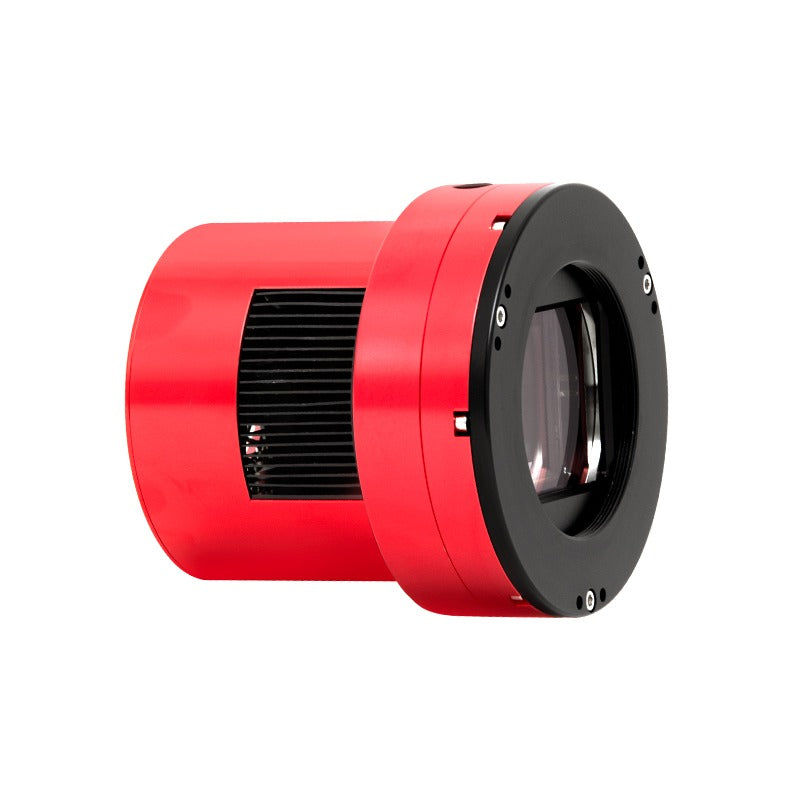
The camera body measures Ø106 mm at the front flange, Ø90 mm at the cooling barrel, and 103 mm long. At 910 g it is light for its format — most quality focusers will carry it without rebalancing the imaging train.
HCG mode and gain selection
Read noise is essentially flat at about 3.1 e⁻ from gain 0 to gain 99, then drops sharply to roughly 1.45 e⁻ the moment HCG engages at gain 100 — while dynamic range actually recovers slightly rather than falling. This is why ZWO recommends gain 0 or gain 100 for deep-sky imaging and nothing in between: gain 50 costs you read noise for no benefit. Dynamic range peaks near 14 stops at unity and declines steadily with gain thereafter.

Quantum efficiency
Absolute QE peaks at 91% near 450 nm and holds above 85% through the blue-green. It falls away steadily through the red — roughly 50% at 700 nm and under 20% beyond 850 nm. In practice this means O-III and H-beta narrowband work is very efficient on this sensor, while deep red and near-IR channels need proportionally longer integration.

Cooling and dark current
Cooling is two-stage, and the 35 °C delta is measured at 30 °C ambient. Expect a smaller delta on a cold night, and smaller again once the cooler has run for several hours — TEC performance is always relative to ambient, never absolute. That behaviour is normal and is not a fault.
The payoff is real: at 0 °C sensor temperature dark current is 0.003 e⁻/s/pixel, so a 300-second sub accumulates about 0.7 e⁻ of dark noise — less than the camera's own read noise. At −20 °C it falls to 0.00024 e⁻/s/pixel, which is negligible by any practical measure. ZWO does not recommend operating the camera below −20 °C.

Recommended Uses
- Wide-field deep-sky imaging of large emission nebulae — the Veil, the North America Nebula, the Rosette — in a single frame rather than a mosaic
- LRGB and narrowband imaging through a filter wheel, where monochrome sensitivity and 91% QE pay for themselves
- Milky Way core and star-field work at short focal lengths where the 44 × 33 mm frame is fully illuminated
- Photometry and scientific imaging requiring 16-bit linearity and a well-characterised low-noise sensor
- Observatory installations where the camera is permanently mounted with dedicated 12 V power
Compatibility and Accessory Notes
- Front thread: M68 × 1 female, for direct connection to a focuser or ZWO's M68 accessory chain
- Backfocus: 22.5 mm from the front flange (17.5 mm in the alternate configuration) — confirm which your imaging train requires before ordering spacers
- Filter wheels: a monochrome sensor needs filters. The matched chain is OAG-L-68 → darkening ring set (D90×D72×T0.2) → EFW 7×50 mm → camera. Filters smaller than 50 mm will vignette a 55 mm sensor diagonal
- Off-axis guiding: the ZWO OAG-L-68 is the correct size for this format and threads directly into the chain above
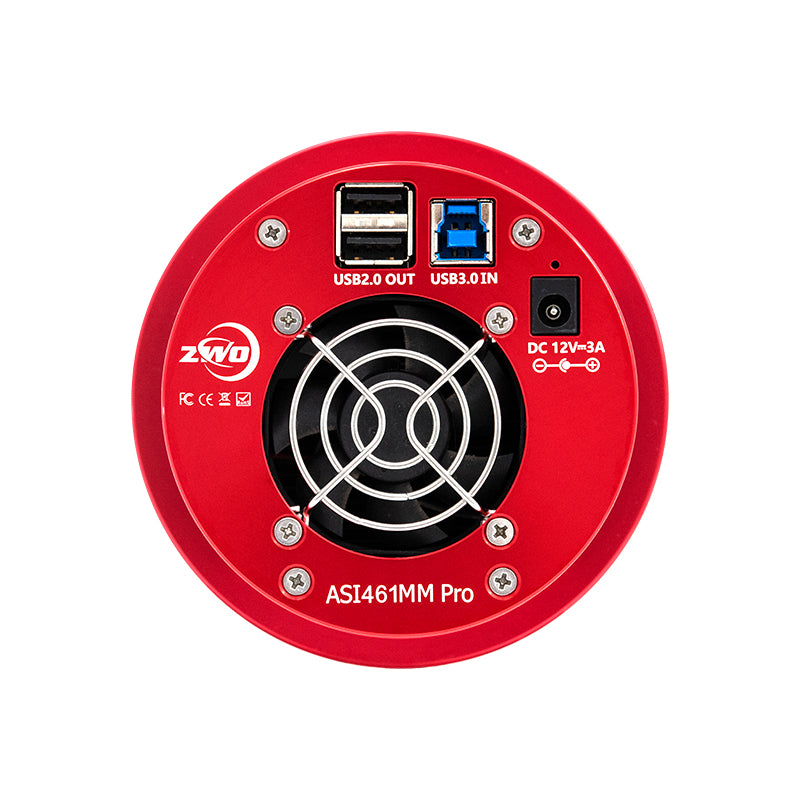
- Power: requires a 12 V DC supply at 3 A minimum, 5.5 × 2.1 mm barrel, centre-positive. Not included
- Software: Windows, Linux, and macOS. Works with ASIAIR, N.I.N.A., SharpCap, and other ASCOM-compatible platforms
- Operating range: −5 °C to 50 °C, 0–80% relative humidity

What's in the box
ASI461MM Pro camera body, padded camera bag, USB 3.0 cable (2 m), two USB 2.0 cables (0.5 m), and a quick guide. The 12 V power supply is not included and is required for operation.

Important Limitations
- Requires external 12 V DC power at 3 A minimum. USB alone will not run the TEC cooler — the camera will not operate correctly powered from a computer port or an ASIAIR hub. The power supply is not included
- Supply voltage outside 11–15 V risks irreparable damage to the camera
- Do not operate below −20 °C sensor temperature — ZWO advises against it, and there is no measurable dark-current benefit below that point
- Not suitable for planetary or lunar high-frame-rate imaging — 3.77 fps at full resolution
- Demands optics corrected for a 55 mm image circle. Smaller corrected circles will vignette
- Monochrome only — colour imaging requires a filter wheel and an LRGB or narrowband filter set, sold separately
- Not a beginner's first camera. The sensor size, filter requirements, and power demands assume an established imaging setup
Frequently Asked Questions
Is the ZWO ASI461MM Pro good for beginners?
No. It is a specialist medium-format camera that requires a filter wheel, dedicated 12 V power, and optics corrected for a 55 mm image circle. If you are starting deep-sky imaging, a cooled one-shot-colour camera on an APS-C sensor is a far better first step.
What gain should I use for deep-sky imaging?
Gain 0 or gain 100, and nothing in between. Read noise stays around 3.1 e⁻ right up to gain 99, then drops to roughly 1.45 e⁻ the instant HCG mode engages at 100. Intermediate gains cost read noise and return nothing.
What is HCG mode?
High Conversion Gain. It switches on automatically at gain 100 and cuts read noise by more than half while leaving dynamic range essentially unchanged. You do not need to enable it manually.
What is the ASI461MM Pro best used for?
Wide-field deep-sky imaging of large targets in a single frame, and narrowband work where monochrome sensitivity and 91% QE shorten integration time. It is also well suited to photometry and research imaging.
Can I use it for planetary imaging?
Not effectively. At 3.77 fps at full resolution it cannot capture the frame rates that lucky imaging depends on.
What backfocus does it need?
22.5 mm from the M68 × 1 front flange, or 17.5 mm in the alternate configuration.
Which filter wheel and off-axis guider should I pair with it?
The ZWO EFW 7×50 mm and the OAG-L-68, assembled as OAG-L-68 → darkening rings → EFW → camera. Filters under 50 mm will vignette the 55 mm sensor diagonal.
Does it need a separate power supply?
Yes. A 12 V DC supply at 3 A minimum (5.5 × 2.1 mm, centre-positive) is required and is not included. USB will not power the cooler.
What telescope do I need for a 44 × 33 mm sensor?
One with a corrected image circle of at least 55 mm. Many refractors marketed as full-frame capable will still show corner fall-off at this diagonal — check the corrected circle, not the marketing claim.
How does it compare to the ASI6200MM Pro?
The ASI6200MM Pro uses a 36 × 24 mm full-frame sensor at 62 MP. The ASI461MM Pro is larger at 44 × 33 mm and 102 MP, with the same 3.76 µm pixel — so it gives more field at the same image scale, at the cost of demanding much more from your optics.
Why is my cooling delta less than 35 °C?
That figure is measured at 30 °C ambient. Delta T falls as ambient temperature falls and after the cooler has run for an extended period. This is expected behaviour for any TEC-cooled camera.
How long can I expose before dark current matters?
At 0 °C, a 300-second sub accumulates roughly 0.7 e⁻ of dark noise — below the camera's read noise. At −20 °C dark current is effectively negligible. Read noise, not dark current, is your limiting factor on this sensor.
Bottom Line
In short: a 102 MP medium-format monochrome sensor for imagers whose optics can genuinely cover 44 × 33 mm. Budget for a 12 V 3 A supply, an EFW 7×50 mm filter wheel, and glass corrected for a 55 mm image circle. Run it at gain 0 or 100 and cool it to 0 °C or below. Get those right and this is among the most capable deep-sky cameras available to amateurs.
| Sensor | Sony IMX461ALR-C CMOS, 3.4″ medium format, monochrome |
|---|---|
| Sensor size | 44 mm × 33 mm (43.856 mm × 32.9 mm active), 55 mm diagonal |
| Resolution | 101.99 MP — 11656 × 8750 |
| Pixel size | 3.76 µm (7.5 µm effective in Bin2) |
| ADC | 16-bit (65,536 levels) |
| Full well | 50.3 ke⁻ (198 ke⁻ in Bin2) |
| Read noise | 1.0 e⁻ minimum; approx. 3.1 e⁻ below gain 100, approx. 1.45 e⁻ with HCG at gain 100 |
| HCG mode | Automatic at gain 100 |
| Recommended DSO gain | Gain 0 or gain 100 |
| Peak QE | 91% (approx. 450 nm) |
| Dynamic range | Up to 14 stops |
| Cooling | Two-stage TEC, 35 °C below ambient (measured at 30 °C ambient) |
| Dark current | 0.003 e⁻/s/pixel at 0 °C; 0.00024 e⁻/s/pixel at −20 °C |
| Dew heater | Polyimide, approx. 5 W, switchable |
| Amp glow | Zero amp glow circuitry |
| Max frame rate | 3.77 fps at full resolution |
| Exposure range | 32 µs – 2000 s |
| Shutter | Rolling shutter |
| Buffer | 256 MB DDR3 |
| Interface | USB 3.0 Type-B |
| Front thread | M68 × 1 female |
| Backfocus | 22.5 mm (17.5 mm alternate configuration) |
| Body dimensions | Ø106 mm front flange, Ø90 mm barrel, 103 mm length |
| Protective window | D79.3-4, AR coated |
| Power | 12 V DC, 3 A minimum, 5.5 × 2.1 mm centre-positive (not included) |
| Weight | 910 g |
| In the box | Camera body, camera bag, USB 3.0 cable (2 m), USB 2.0 cable (0.5 m) × 2, quick guide |
| Operating temperature | −5 °C to 50 °C (do not cool sensor below −20 °C) |
| Operating humidity | 0–80% RH |
| Supported OS | Windows, Linux, macOS |
| Recommended use | Wide-field deep-sky and narrowband imaging; photometry and research |
You may also like
Recently viewed
Recent Blog Posts
View all
Your Guide Graph Is Lying to You
Read More

D-Size vs V-Size: A Complete Guide to Telescope Dovetail Systems
Read More

What Is Back Focus in Astrophotography? Telescope Reducers, Flatteners, and Spacing Explained
Read More