

- Description
- Specifications
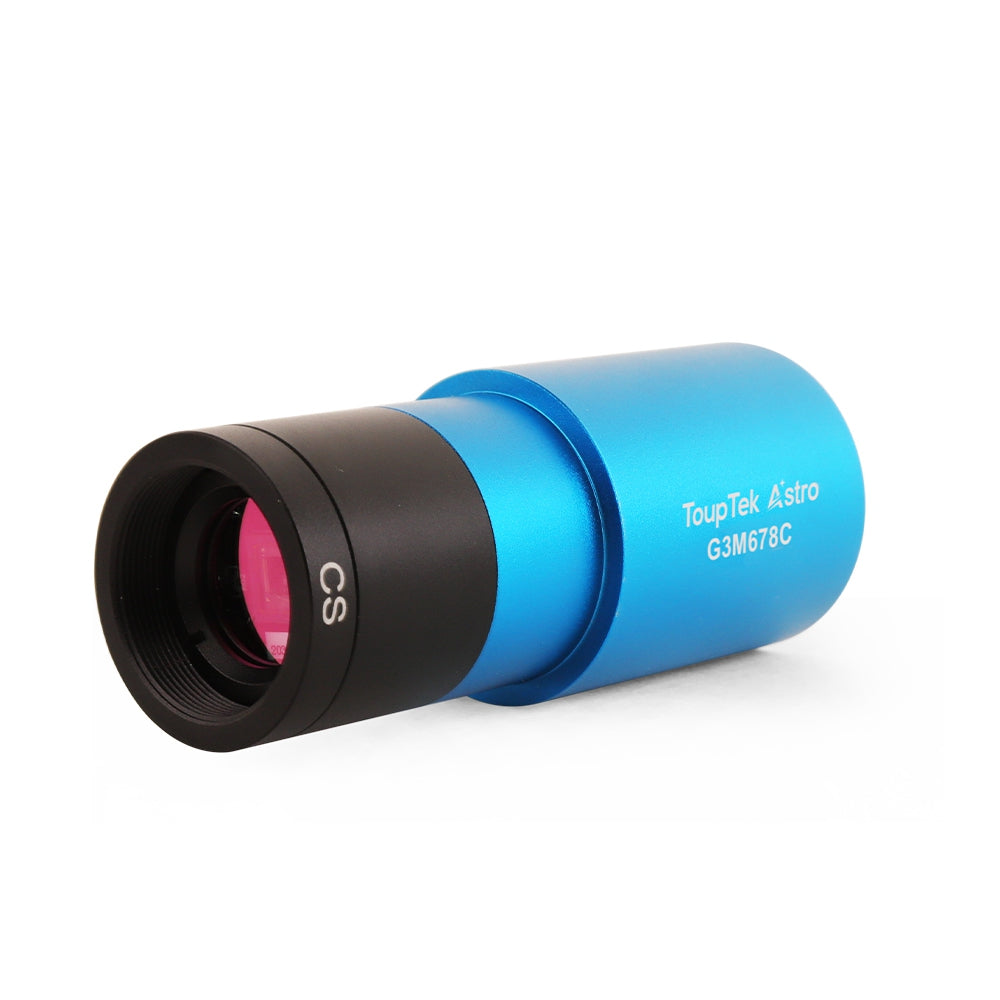
The ToupTek G3M678C is a high-resolution 4K colour planetary camera built around the Sony IMX678 back-illuminated STARVIS 2 CMOS sensor. At 8.3 megapixels (3840×2160) with a 2.0 µm pixel pitch, the G3M678C captures planetary detail at a level impossible with smaller-sensor cameras. Whether you are mapping Jupiter's cloud bands at high magnification or building detailed lunar mosaics, the IMX678's combination of resolution, HCG/LCG gain modes, and zero amp-glow technology makes it a serious instrument.
Product Overview
The G3M678C uses the Sony IMX678 4K BSI sensor in a colour (RGGB Bayer) configuration. Despite its high resolution, the camera achieves up to 47 FPS at full 3840×2160, with significantly higher rates possible using hardware ROI. The 512MB DDR3 buffer ensures stable USB 3.0 transmission even at sustained high data rates. HCG mode minimizes read noise for dark planetary targets, while LCG mode maximizes the full well for bright discs. Both the Standard (17.5mm) and Extended (12.5mm, OAG-compatible) versions are available.
Who Is This Product Best For?
The G3M678C is for advanced planetary imagers who want maximum pixel count and field coverage for high-magnification work. The large 4K sensor allows imaging entire planets at high focal lengths without needing a camera rotator, and the improved field coverage is ideal for multi-planet conjunction images or full-disc lunar captures.
Why Choose This Product?
- 8.3MP 4K Sony IMX678 STARVIS 2 sensor — captures far more planetary detail per frame than 2MP cameras
- 2.0 µm pixel pitch — small pixels for high spatial sampling at long focal lengths
- HCG / LCG mode switching — adapt to target brightness and imaging conditions
- >83% peak QE — strong sensitivity including deep into the near-infrared
- 0.5–2.55 e⁻ read noise — clean frames across the full gain range
- 47 FPS at full 4K resolution — practical for planetary lucky imaging even at high resolution
- 512MB DDR3 buffer + zero amp-glow — reliable, clean data transmission
- 74 dB dynamic range — excellent tonal control across bright and shadowed planetary features
Recommended Uses
- High-resolution planetary imaging — Jupiter, Saturn, Mars at high magnification
- Full-disc and detailed lunar imaging and mosaic work
- Solar imaging with appropriate filters
- Lucky imaging and video stacking (AutoStakkert!, RegiStax)
- Wide-field planetary conjunction captures
Compatibility and Accessory Notes
- Connection: Standard C-mount (17.5mm) or Extended version (12.5mm, OAG-compatible)
- Filters: 1.25" mounted filters via the included extension tube
- Spectral range: 380–1100 nm (extended NIR response)
- Software: ToupSky, SharpCap, FireCapture, NINA, PHD2, ASCOM; INDI for Linux
- Power: USB 3.0 bus-powered
Important Limitations
- Not designed for deep-sky imaging — uncooled sensor; long exposures accumulate thermal noise
- Not for visual observing — requires computer and capture software
- Colour sensor — the G3M678M (monochrome) is preferred for narrowband and LRGB workflows
- Higher data rates — a fast USB 3.0 host controller and SSD are recommended for sustained 4K capture
Frequently Asked Questions
How does the G3M678C compare to the G3M662C?
The G3M678C has 4× the pixel count (8.3MP vs 2.1MP) and smaller 2.0 µm pixels, allowing much more detail per frame at high focal lengths. The trade-off is lower frame rate (47 vs 103 FPS). For fine planetary detail mapping, the 678C wins. For very fast seeing-limited work, the 662C's higher frame rate may be advantageous.
What computer specs do I need for 4K capture?
A modern PC with a dedicated USB 3.0 host controller and a fast NVMe SSD (500MB/s+) is recommended for sustained 4K capture. Laptop USB hubs and older USB 3.0 controllers can struggle at maximum frame rates.
Can the G3M678C be used for guiding?
Yes, though its large sensor and higher data rate make it less typical for guiding than smaller cameras. It will work with PHD2 and NINA, but a smaller guide camera like the GPM290C is usually a better dedicated guiding choice.
Our Recommendation
The ToupTek G3M678C is the right choice for planetary imagers who want the highest possible detail per frame and are comfortable working with larger data files. The 4K 8.3MP IMX678 sensor gives a real and visible advantage for high-magnification planetary work. For narrowband or LRGB imaging, choose the G3M678M. For faster high-frame-rate work at lower resolution, the G3M662C is the better pick. For deep-sky imaging, see our ToupTek ATR and SkyEye cooled cameras.
| Specification | Detail |
|---|---|
| Sensor | Sony IMX678 STARVIS 2 (Colour, RGGB Bayer) |
| Sensor Format | 1/1.8" |
| Resolution | 8.3 MP / 4K (3840 × 2160) |
| Pixel Size | 2.0 µm |
| Peak QE | >83% (strong NIR response to 850nm) |
| Read Noise | 0.5–2.55 e⁻ |
| Full Well Capacity | 11.6 ke⁻ |
| Dynamic Range | 74 dB |
| Max Frame Rate | 47 FPS @ 3840×2160 (USB 3.0) |
| ADC | Native 12-bit (16-bit output via 2×2 binning) |
| Buffer | 512MB DDR3 |
| Gain Modes | HCG, LCG |
| Interface | USB 3.0 |
| Back Focus (Standard) | 17.5 mm (C-mount) |
| Back Focus (Extended) | 12.5 mm (OAG-optimized) |
| Mount | C-mount / CS-mount |
| Filter Compatibility | 1.25" mounted filters via extension tube |
| Binning | Digital 1×1 to 8×8; Hardware 1×1 to 2×2 |
| Hardware ROI | Yes |
| Cooling | None (uncooled) |
| Amp Glow | Zero amp-glow (hardware level) |
| Power | USB 3.0 bus-powered |
| OS Compatibility | Windows, Linux, macOS (INDI) |
| Software | ToupSky, SharpCap, FireCapture, NINA, PHD2, ASCOM |
| Spectral Range | 380–1100 nm (extended NIR) |
You may also like
Recently viewed
Recent Blog Posts
View all
Your Guide Graph Is Lying to You
Read More

D-Size vs V-Size: A Complete Guide to Telescope Dovetail Systems
Read More

What Is Back Focus in Astrophotography? Telescope Reducers, Flatteners, and Spacing Explained
Read More