

- Description
- Specifications
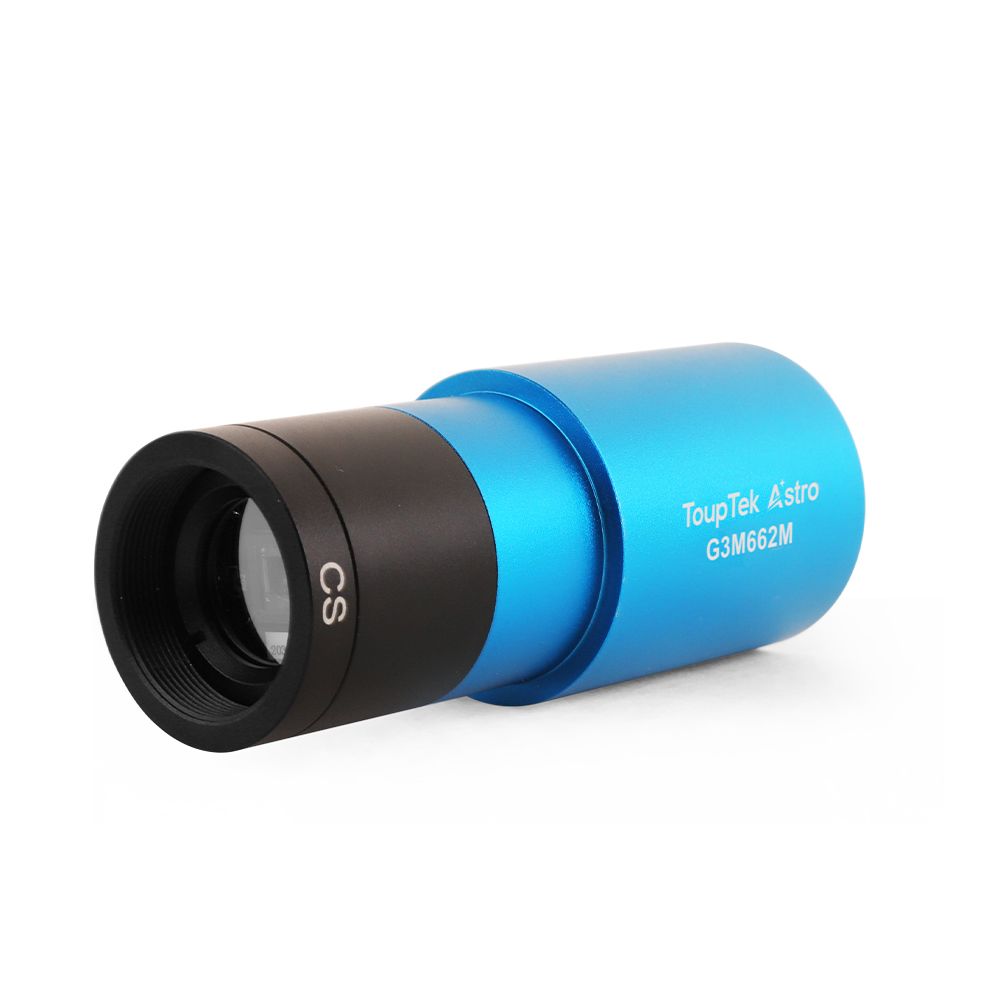
The ToupTek G3M662M is the monochrome version of the G3M662C, delivering maximum sensitivity and resolution from Sony's IMX662 STARVIS 2 back-illuminated sensor without the Bayer colour filter. Removing the colour mosaic exposes the sensor's full resolving power and sensitivity — making the G3M662M the preferred choice for narrowband solar imaging, infrared planetary work, and demanding LRGB planetary sequences. With 103.4 FPS at full resolution, HCG/LCG/HDR gain modes, and a hardware-level zero amp-glow design, it sets a high bar for compact monochrome planetary performance.
Product Overview
The G3M662M is built around the Sony IMX662 1/2.8" STARVIS 2 BSI monochrome sensor. The 512MB DDR3 buffer ensures stable USB 3.0 throughput and further reduces amp-glow from buffered image data. HCG mode achieves the camera's lowest read noise (0.46 e⁻), while LCG mode maximizes the full well capacity (39 ke⁻) for bright targets. HDR mode covers both. Hardware ROI and both digital and hardware binning are supported.
Who Is This Product Best For?
This camera is for intermediate and advanced imagers who want the absolute best from a compact planetary platform. Dedicated H-alpha solar imagers, narrowband planetary specialists, and LRGB imagers will all benefit from the monochrome IMX662's improved sensitivity and per-pixel resolution over colour equivalents.
Why Choose This Product?
- Monochrome IMX662 STARVIS 2 sensor — full per-pixel sensitivity without Bayer demosaicing loss
- 0.46 e⁻ minimum read noise — among the lowest available in a compact planetary camera
- 39 ke⁻ full well capacity — excellent dynamic range for planetary disc imaging
- 103.4 FPS at full resolution — fast enough for effective lucky imaging on any planetary target
- HCG / LCG / HDR gain modes — flexible configuration for different targets and conditions
- 512MB DDR3 buffer + zero amp-glow — consistently clean captures at any gain or exposure
- Narrowband compatible — H-alpha, Ca-K, and IR-pass filters all work well with this sensor
Recommended Uses
- H-alpha and Ca-K narrowband solar imaging
- Near-infrared planetary imaging to cut through atmospheric dispersion
- LRGB planetary sequences for maximum colour detail
- High-resolution lunar imaging
- Autoguiding on a guide scope or OAG
- Lucky imaging on bright deep-sky objects and double stars
Compatibility and Accessory Notes
- Connection: Standard C-mount (17.5mm back focus) or Extended version (12.5mm back focus for OAG use)
- Filters: Accepts 1.25" mounted filters via the included extension tube; narrowband and IR-pass filter compatible
- Software: ToupSky, SharpCap, FireCapture, NINA, PHD2, ASCOM; INDI for Linux
- Power: USB 3.0 bus-powered — no external supply required
Important Limitations
- Monochrome output only — requires colour filters for LRGB imaging or single narrowband channel output
- Not for deep-sky imaging — no TEC cooling; thermal noise accumulates in long exposures
- Not for visual observing — requires computer and capture software
Frequently Asked Questions
What is the advantage of the G3M662M over the G3M662C?
The monochrome sensor delivers higher per-pixel sensitivity and resolution because every pixel captures all incoming light rather than being split by a Bayer colour filter. This matters most for narrowband imaging (H-alpha, Ca-K) and for LRGB workflows where each colour channel is imaged separately.
How does the G3M662M compare to the G3M462M?
The IMX662 STARVIS 2 in the G3M662M has lower read noise (0.46 vs 0.49 e⁻), a much larger full well (39 ke⁻ vs 11.8 ke⁻), HCG/LCG/HDR mode switching, and higher dynamic range. It is a meaningful performance upgrade, especially for bright planet and solar disc imaging where the larger full well prevents overexposure.
Can the G3M662M be used for autoguiding?
Yes — and the monochrome sensor makes it an excellent guide camera. PHD2 and NINA both support ToupTek cameras natively.
Our Recommendation
The ToupTek G3M662M is our top recommendation for compact monochrome planetary imaging at this price point. The STARVIS 2 sensor's combination of low noise, large full well, and flexible gain modes makes it a genuine upgrade over older IMX462-based cameras. Choose this over the G3M662C when you want maximum performance, plan to use narrowband filters, or are doing LRGB imaging. For deep-sky work, see ToupTek's ATR and SkyEye cooled cameras.
| Specification | Detail |
|---|---|
| Sensor | Sony IMX662 STARVIS 2 (Monochrome) |
| Sensor Format | 1/2.8" |
| Resolution | 2.1 MP (1920 × 1080) |
| Pixel Size | 2.9 µm |
| Peak QE | >91% |
| Read Noise | 0.46 e⁻ min (HCG mode) |
| Full Well Capacity | 39 ke⁻ (LCG mode) |
| Dynamic Range | 77 dB |
| Max Frame Rate | 103.4 FPS @ 1920×1080 (USB 3.0) |
| ADC | Native 12-bit (16-bit output via 2×2 binning) |
| Buffer | 512MB DDR3 |
| Gain Modes | HCG, LCG, HDR |
| Interface | USB 3.0 |
| Back Focus (Standard) | 17.5 mm (C-mount) |
| Back Focus (Extended) | 12.5 mm (OAG-optimized) |
| Mount | C-mount / CS-mount |
| Filter Compatibility | 1.25" mounted filters; narrowband and IR-pass compatible |
| Binning | Digital 1×1 to 8×8; Hardware 1×1 to 2×2 |
| Hardware ROI | Yes |
| Cooling | None (uncooled) |
| Amp Glow | Zero amp-glow (hardware level) |
| Power | USB 3.0 bus-powered |
| OS Compatibility | Windows, Linux, macOS (INDI) |
| Software | ToupSky, SharpCap, FireCapture, NINA, PHD2, ASCOM |
You may also like
Recently viewed
Recent Blog Posts
View all
Your Guide Graph Is Lying to You
Read More

D-Size vs V-Size: A Complete Guide to Telescope Dovetail Systems
Read More

What Is Back Focus in Astrophotography? Telescope Reducers, Flatteners, and Spacing Explained
Read More