
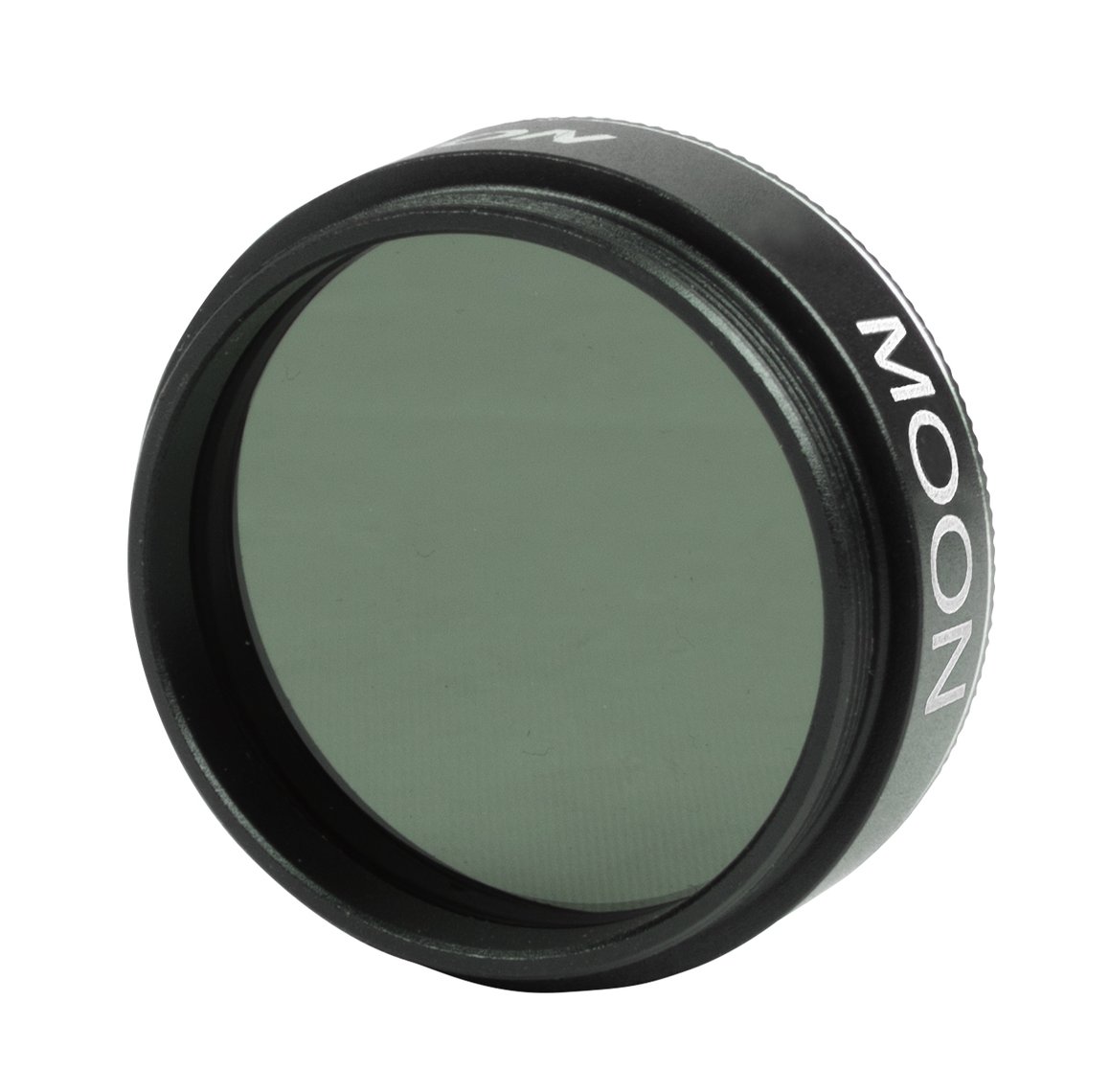

- Description
The Moon has the distinction of being the most often viewed celestial object through backyard telescopes. It is undoubtedly beautiful and mysterious, and is one of those constants in our lives that connects us to every other being on our planet. Regardless of who we are or where we live or travel, we all look at the same moon.
It is difficult to look at the Moon through a telescope and see all of the details due to its brightness. Our eyes are not ready for the bright beam of light that emits from the eyepiece, and they “stop down”, just as they would when you step out into the sunlight on a bright summer’s day. When we’re in the sunlight, we often wear sunglasses. They help us relax our eyes, protect us from glare, and help us see things more clearly. When amateur astronomers observe the Moon, we use a moon filter. A Celestron Moon Filter provides similar benefits to those of sunglasses...our eye relaxes and opens up to let us see more detail. This is especially important when observing the Moon when it is near full.
The Celestron Moon Filter simply screws onto the insert barrel of most 1.25” eyepieces. It only takes a second or two to transform your regular eyepiece into one suited for lunar observations. A Moon Filter is also helpful when observing Venus or bright terrestrial scenes. This filter is not suitable for viewing the Sun.
You may also like
Recently viewed
Recent Blog Posts
View all
Your Guide Graph Is Lying to You
Read More

D-Size vs V-Size: A Complete Guide to Telescope Dovetail Systems
Read More

What Is Back Focus in Astrophotography? Telescope Reducers, Flatteners, and Spacing Explained
Read More