


- Description
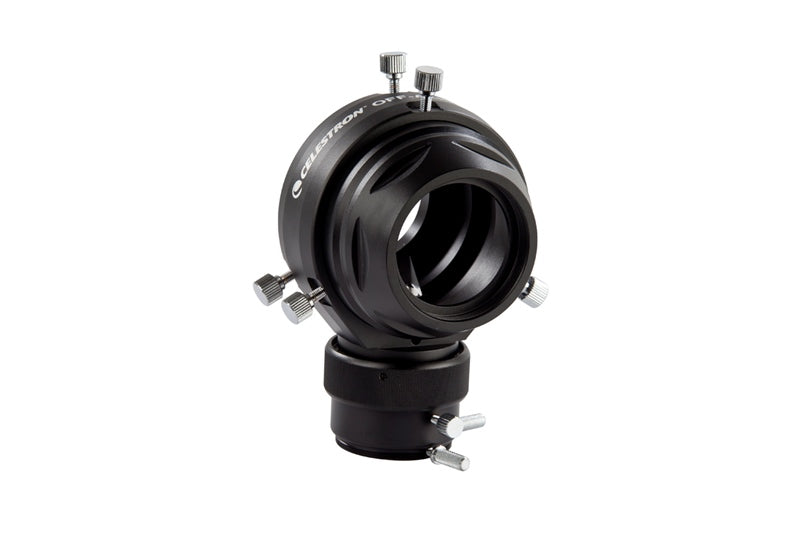
The Celestron off-axis guider #OAG93648 is an essential accessory for astroimaging with DSLRs or a CCD camera/separate CCD guider combination. It is particularly useful with long focal length telescopes that require the most accurate guiding possible. The #OAG93648 has a 48mm clear aperture that supports full frame cameras without vignetting.
Using an off-axis guider eliminates the possibility of differential flexure (and its resulting star trails in your images) that can arise when using a separate photoguide telescope.
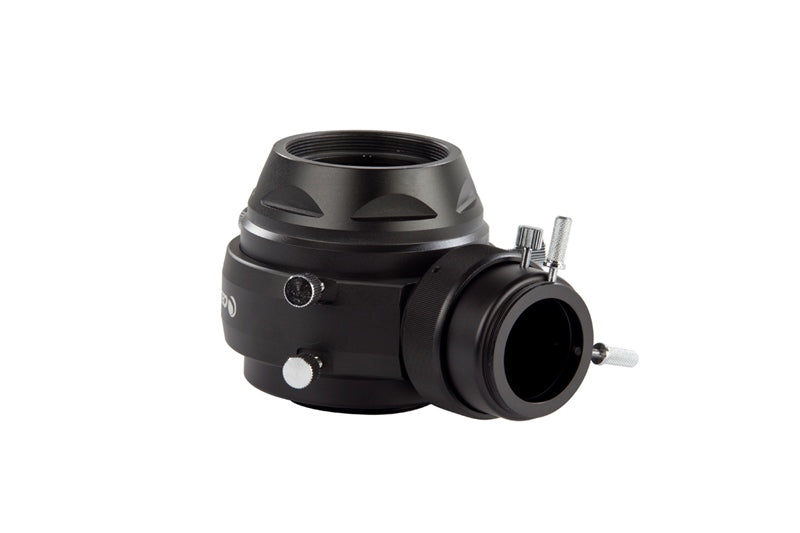
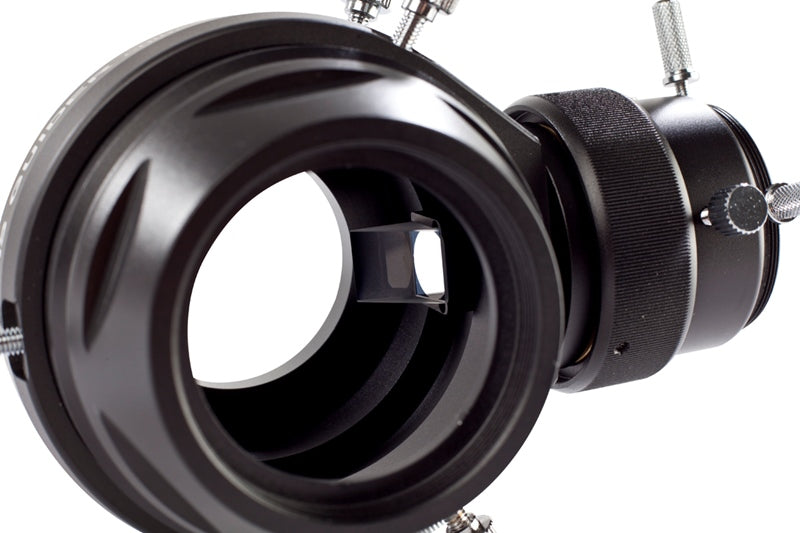
The Celestron off-axis guider #OAG93648 mounts securely onto the rear cell or focuser of your telescope. The guider has a small prism off to one side of the guider body that intercepts a portion of the telescope s light cone (outside the field of view of the main imaging camera) to locate a guide star. Any movement of the guide star in the guider will be the exact same movement seen by the imaging camera mounted at the rear of the guider body. Guiding this way corrects for tracking errors, as well as any opto-mechanical errors or flexure in a separate photoguide scope. The result is better astroimages with pinpoint round stars.
Off-axis guiders have been around for a long time, but typically pose three main challenges:
The first challenge is that finding a guide star at the far edges of the telescope s focal plane can be difficult, considering the small field of view and sometimes less-than-ideal illumination. Celestron addresses this challenge by providing a large 12.5mm multicoated prism with aluminized backing for maximum reflectivity and illumination to the autoguider. The prism can be adjusted to move in and out of the telescope s light path, depending on the size of the chip in the imaging camera. This results in brighter guide stars, with the help of the large prism to fully illuminate the autoguider sensor. In addition, the guider body can be rotated to find a guide star.
The second challenge is that getting both imaging camera and autoguider to reach focus with one another is time consuming and sometimes requires experimentation. Celestron helps here by using a high-quality, fixed-orientation Helical focuser with 8mm of focuser travel. This provides extremely smooth and accurate focus of the autoguider without changing (or twisting) the autoguider camera orientation.
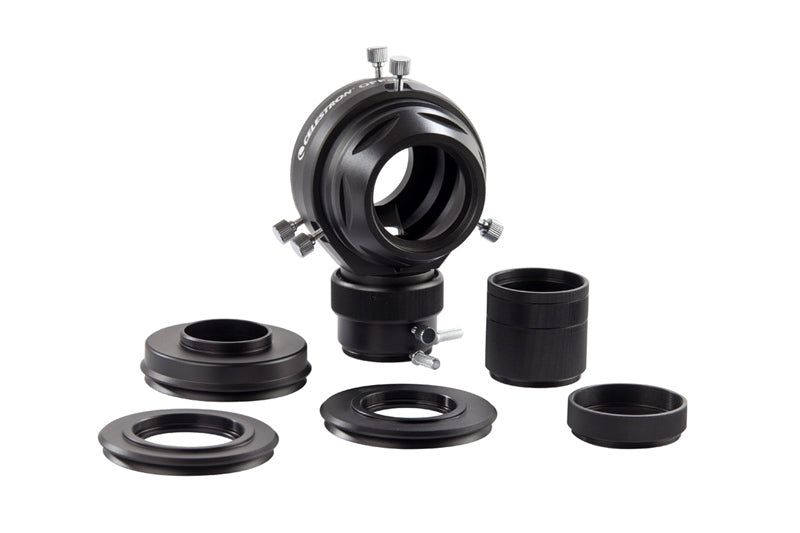
The third challenge is that additional spacers and adapters are usually required for your particular camera, telescope, and autoguider, which adds to cost and complexity. Celestron helps here by including all the spacers and adapters needed for most common imaging configurations, including DSLR cameras, Nightscape CCD cameras, and other popular astroimaging cameras. The following adapters are included: for telescope connection you get M42 T-thread, M48, and SCT/EdgeHD adapters; for CCD guider to autoguider connection you get M42 T-thread, and standard 1.25" adapters; and for camera connection you get M42 T-thread and M48 adapters and T-thread spacers.
Some telescopes, primarily Newtonian reflectors and some refractors, will not have enough focuser in-travel accomodate the Celestron Off-Axis Guider. To help in configuring the Celestron off-axis guider #OAAG93648 to the available back focus of your particular telescope the following dimensions are the actual amount of back focus used by each of the adapters:
OAG body: 29mm
SCT adapter: 25.3mm
Male M42 and M48 camera adapters: 12.5mm
Female M42 and M49 telescope adapters: 4.5mm
Short T-thread spacer ring: 6mm
Meadium T-thread spacer ring: 11.55mm
Long T-thread spacer ring: 24.25mm
Medium M48 spacer ring: 11.55mm
You may also like
Recently viewed
Recent Blog Posts
View all
Your Guide Graph Is Lying to You
You drove ninety minutes to dark sky, PHD2 held 0.4 arcseconds all night, and half your subs still have eggs for stars. Here are the three things your
Read More
Read More

D-Size vs V-Size: A Complete Guide to Telescope Dovetail Systems
What's the difference between D-size and V-size telescope dovetails? Here's everything you need to know.
Read More
Read More

What Is Back Focus in Astrophotography? Telescope Reducers, Flatteners, and Spacing Explained
What Is Back Focus in Astrophotography? Telescope Reducers, Flatteners, and Spacing Explained
Back focus is one of those astrophotography terms that c
Read More
Read More